
Antibacterial activity of myrtus, thyme and calendula essential oils
2023
0 views
0 downloads
Advisor: Doç. Dr. Azime Küçükgül ; Dr. Öğr. Üyesi Pınar Erecevit Sönmez
Abstract (EN)
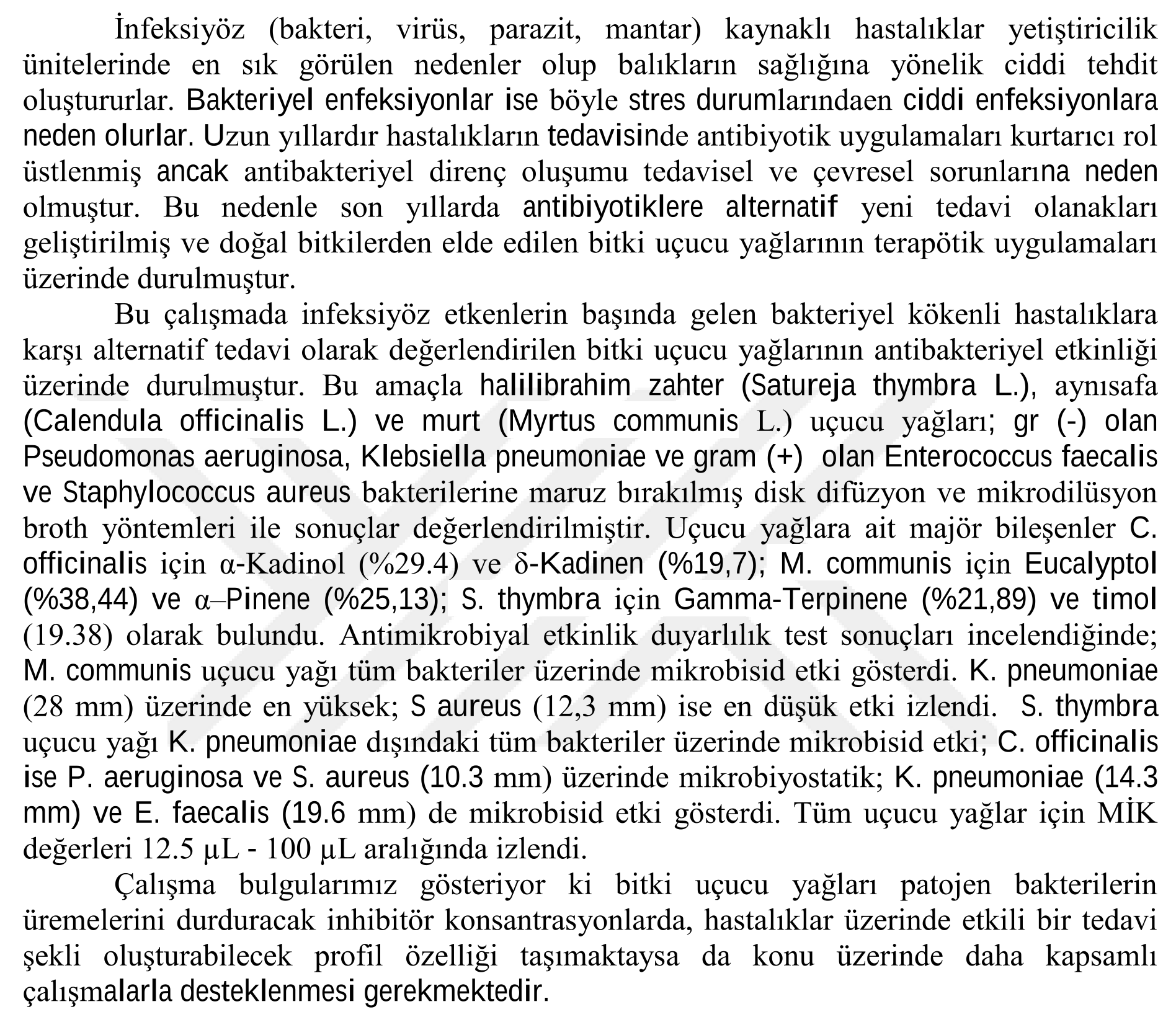
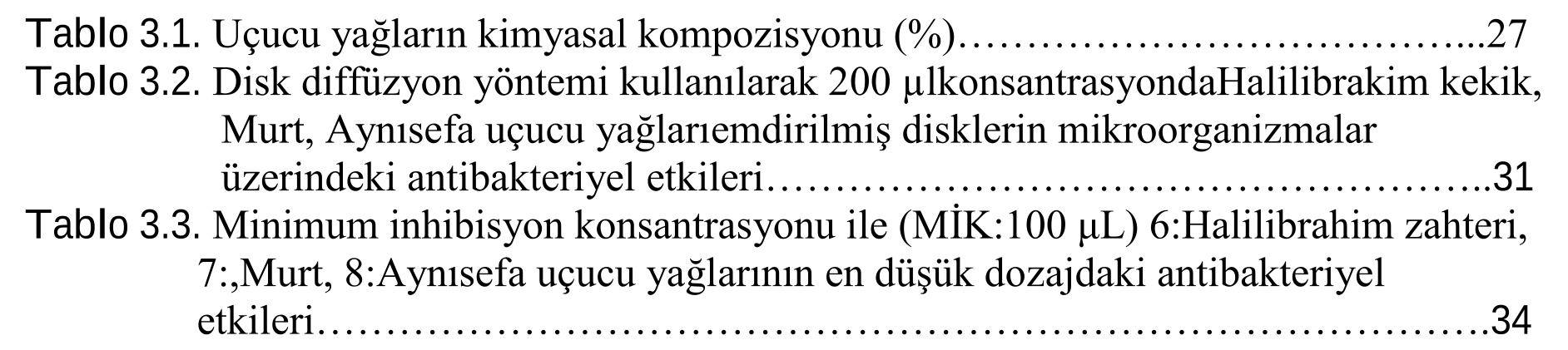
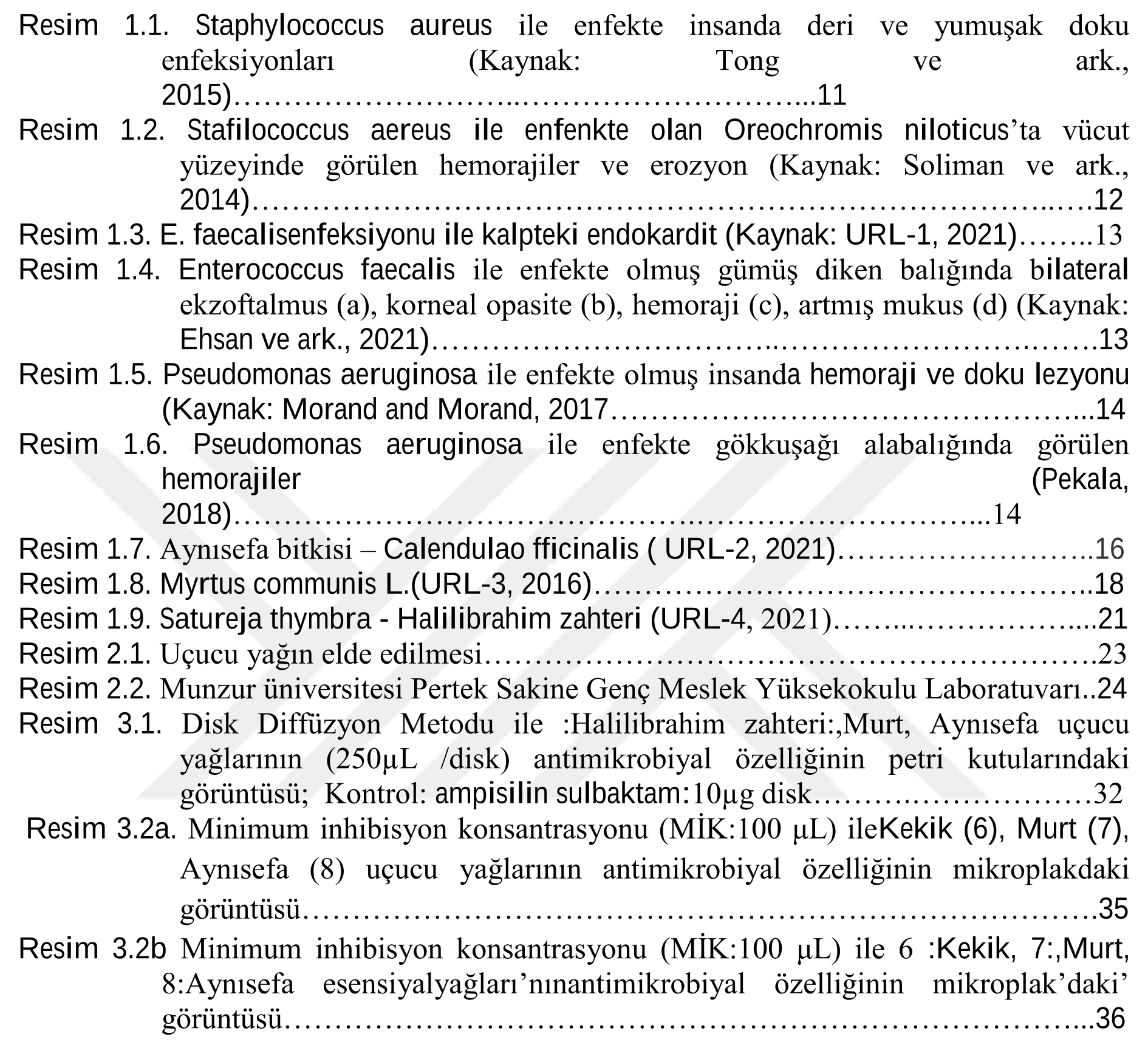
Diseases originating from infectious (bacteria, virus, parasite, fungus) are the most common causes in aquaculture units and pose a serious threat to the health of fish. Bacterial infections, on the other hand, cause the most serious infections in such stress situations. Antibiotic applications have played a saving role in the treatment of diseases for many years, but the formation of antibacterial resistance has caused therapeutic and environmental problems. For this reason, in recent years, alternative treatment possibilities to antibiotics have been developed and the therapeutic applications of plant essential oils obtained from natural plants have been emphasized. In this study, the antibacterial activity of plant essential oils, which is considered as a alternative treatment against bacterial diseases, which is one of the leading infectious agents, was emphasized. For this purpose, essential oils of halilibrahim zahter (Satureja thymbra L.), calendula (Calendula officinalis L.) and murt (Myrtus communis L.) were exposed to gram (-) Pseudomonas aeruginosa, Klebsiella pneumoniae and gram (+) Enterococcus faecalis and Staphylococcus aureus bacteria and the results were evaluated by disc diffusion and microdilution broth methods. The major components of essential oils were α-Kadinol (29.4%) and δ-Kadinen (19.7%) for C. officinalis; Eucalyptol (38.44%) and α–Pinene (25.13%) for M. communis; Gamma-Terpinene (21.89%) and thymol (19.38) were found for S. thymbra. When the antimicrobial efficacy susceptibility test results are examined; M. communis essential oil showed a microbicidal effect on all bacteria. The highest effect had on K. pneumoniae (28 mm) and had the lowest on S aureus (12.3 mm). S. thymbra essential oil has a microbicidal effect on all bacteria except K. pneumoniae; C. officinalis was microbiostatic on P. aeruginosa and S. aureus (10.3 mm); K. pneumoniae (14.3 mm) and E. faecalis (19.6 mm) also showed microbicide effect. MIC values for all essential oils were monitored in the range of 12.5 µL - 100 µL. Our study findings show that although plant essential oils have inhibitory concentrations that will stop the growth of pathogenic bacteria, they have a profile that can create an effective treatment method on diseases, but it needs to be supported by more comprehensive studies on the subject.
Author
Ali Bozkaya

How to Cite
Ali Bozkaya (Master Thesis). Antibacterial activity of myrtus, thyme and calendula essential oils, 2023, Munzur University.
Figures & Images (97)
Keywords
License
Tüm Hakları Saklıdır
This work is shared under the specified license terms.
More theses from Munzur University
- Production of composites by reinforcing basalt fibers to polymers obtained from battery recycling-investigation of mechanical, thermal and morphological properties of composites(2023)
- Contact problem analysis in functionally graded layers with machine learning method(2023)
- Investigation of the usability of Neodymium/Alginate beads for dye removal(2023)
- Thinking ecology and feminism together: The ecofeminism of Carol J. Adams(2023)
- Investigation on the effect of positive psychological capital on job satisfaction in working life(2023)
- Physico-chemical and epilithic algal flora of pülümür stream (Tunceli)(2023)