
 indexed
The relationship between sustainable urbanization, natural disasters and vulnerability in developing countries: An analysis of the role of income inequality
2026
1 pages
3 views
1 downloads
Advisor: Doç. Dr. Hikmet AKYOL
Abstract (EN)
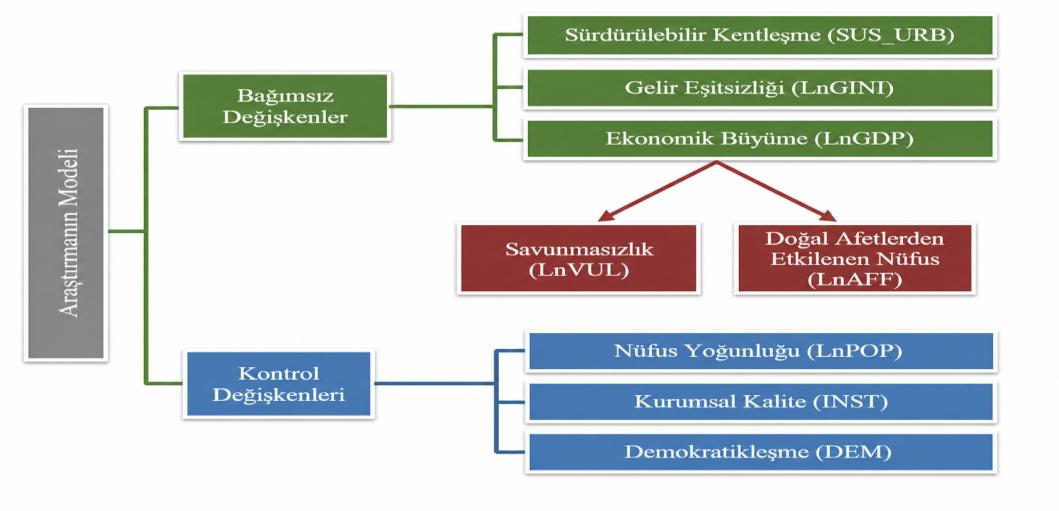
This study examines how the relationship between sustainable urbanization, vulnerability, and natural disasters in developing countries is shaped within the context of income inequality. Rapid urbanization processes, combined with increasing population density, environmental degradation, and socioeconomic disparities, have made disaster risks more complex and multidimensional. Particularly in societies with high levels of income inequality, the concentration of low-income groups in hazard-prone areas intensifies the social impacts of disasters and increases vulnerability. The main objective of this research is to empirically investigate the effects of sustainable urbanization, income inequality, and institutional factors on vulnerability and the population affected by natural disasters. For this purpose, a panel dataset covering thirty-one developing countries for the period 2002–2023 was employed. In the empirical analysis, cross-sectional dependence and heterogeneity tests were conducted, while the stationarity properties of the variables were examined using the CADF-CIPS and unit root tests. A cointegration test was applied to determine the existence of long-run relationships among the variables. Coefficient estimates were obtained using the Driscoll–Kraay, Ridge, FGLS, and PCSE estimators. In addition, the Bootstrap Quantile Regression approach was employed to reveal the effects of the variables across different levels of vulnerability. The empirical findings indicate that sustainable urbanization and institutional quality significantly reduce vulnerability and the population affected by natural disasters. In contrast, income inequality and population density emerge as the main factors that increase disaster risks. The quantile regression results further demonstrate that the impact of income inequality varies across different vulnerability levels and becomes more pronounced in highly vulnerable countries. Overall, the study highlights the critical importance of promoting sustainable urbanization policies, reducing income inequalities, and strengthening institutional capacity in order to mitigate disaster risks and enhance societal resilience.

How to Cite
Yasin Çatalbaş (Master Thesis). The relationship between sustainable urbanization, natural disasters and vulnerability in developing countries: An analysis of the role of income inequality, 2026, pp. 1-1, Gümüşhane University, DOI: https://doi.org/10.71008/gumushane.thesis.2026.198.
Figures & Images (6)




DOI Status
Requested
Under Review
Approved
DOI Assigned
DOI & Cite
License
Tüm Hakları Saklıdır
This work is shared under the specified license terms.
More theses from Gümüşhane University
- RÜZGAR ENERJİSİ SANTRALİ İÇİN YER SEÇİM ANALİZİ: GİRESUN İLİ ÖRNEĞİ(2026)
- Francis Bacon's understanding of induction(2024)
- Investigation of the effects of the French contrast method, a post activation model, on jump force and speed performance in amateur handball players(2025)
- GÜMÜŞHANE DEVLET HASTANESİNDEKİ HEMŞİRELERİN AFET TEHDİDİ İÇİN PSİKOLOJİK HAZIRLIKLARININ BELİRLENMESİ(2026)
- Performance evaluation of deep learning models for intrusion detection using network traffic(2026)
- Structure and theme in Sibel K. Türker’s novels(2026)