
Investigation of the effect of thermal bridge at symetrical corners on typical wall constructions approved by the Ministry of Public Works
1991
0 views
0 downloads
Advisor: Doç. Dr. Lemi Yücesoy
Abstract (EN)
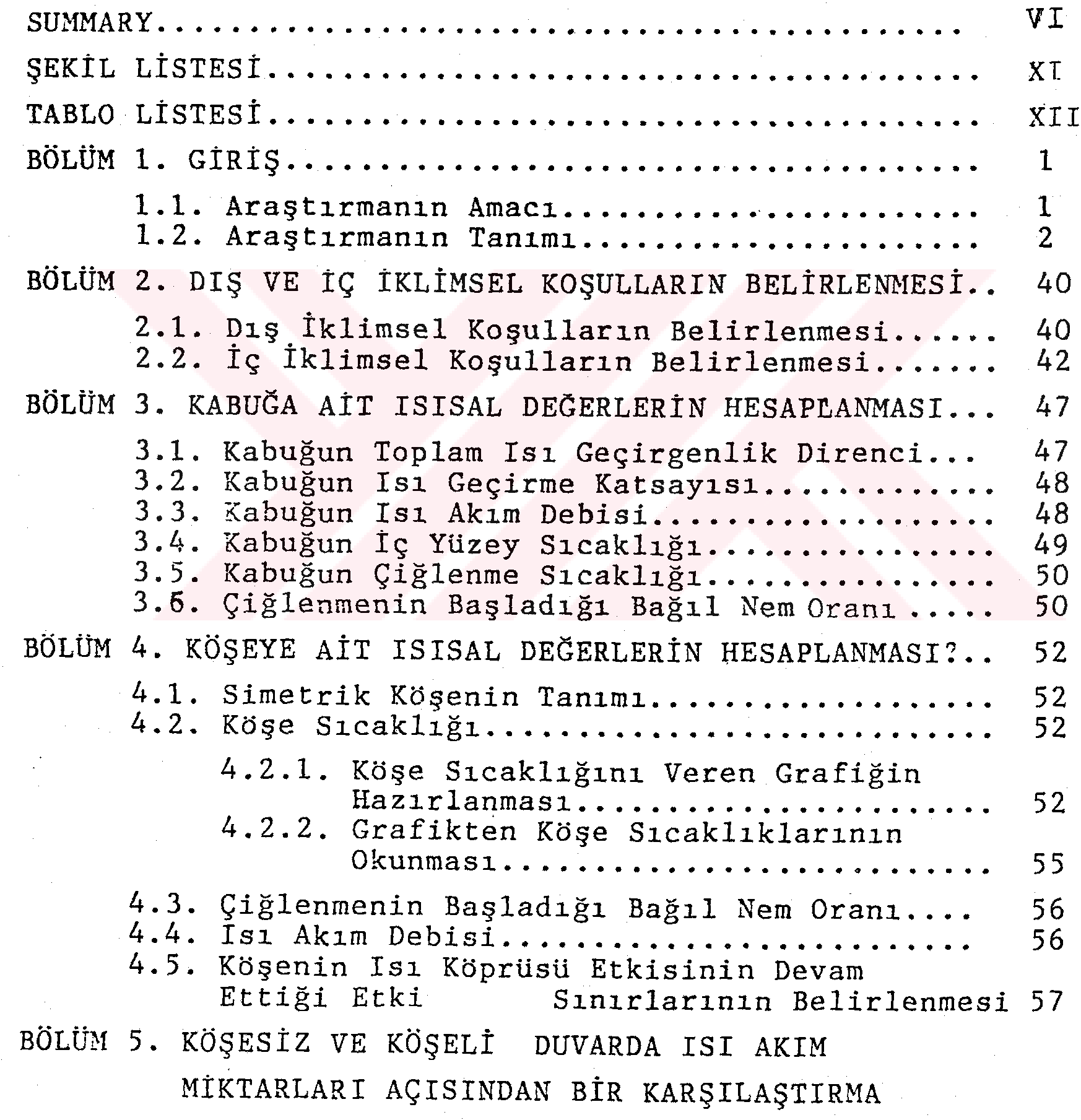
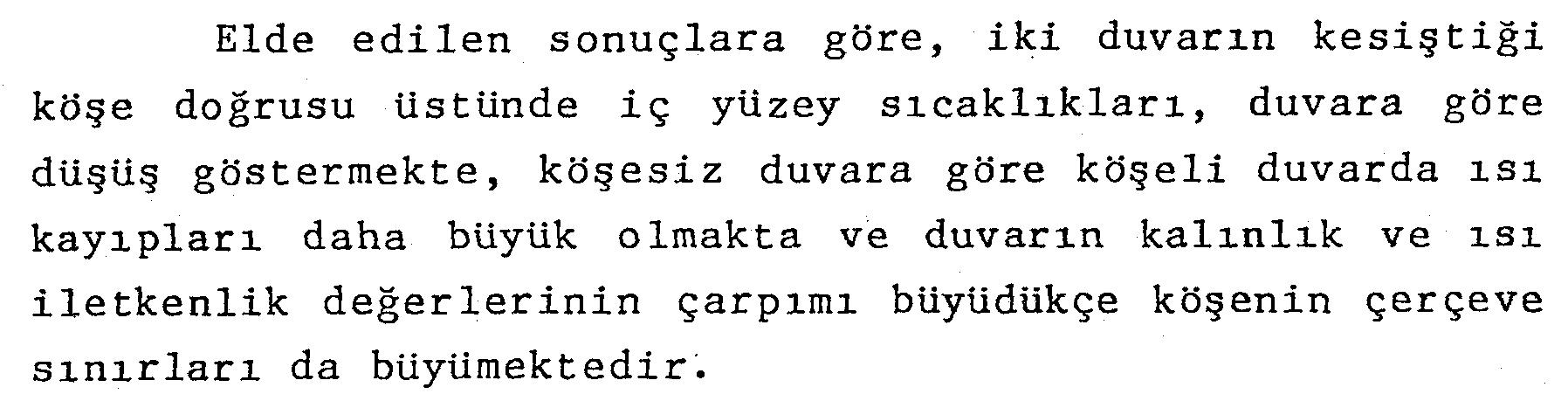
In this study, internal surface temperatures of the wall and the corner and the effect of corner's thermal bridge on the wall have been investigated according to the thermal values given in The Building Regulations on Heat Insulation (TS 825). For this reason, ten wall types for the 1st Climate Zone, twelve for the 2nd and fourteen four the 3rd have been chosen. The study has been realised at four stage: 1. Stage: Definition of the external climatic conditions 2. Stage: Calculation of the thermal values which belong to the wall 3. Stage: Calculation of the thermal values which belong to the corner 4. Stage: Comperison in respect of heat transfer quantities at cornered and uncornered walls. At first stage, a pilot city for every climate zone has been chosen. These pilot cities are located in the geographical center of these zones. Also external climatic conditions have been taken from the winter datas (Table 2.2). The internal relative humidity, the internal air temperature, the dewpoint temperature and heat convection coefficient of internal surface have been chosen for VIdefinition of the internal climatic condition. These values have been chosen as 55%, 18 °C and 8,14 W/m2°C respectively. At second stage, thermal values which belong to the wall have been calculated. These values are as fallows: Resistance of heat transfer: 1/ d, d0 dQ d XA = l, 2, 3.,... L m'°C/W Xl X2 A3 An Coefficient of heat transfer: k = 1 W/m2°C " 1 + -L. + ! ^i A «j Heat transfer rate of flow: q= k. A W/ra2 Internal surface temperature of the wall: Dewpoint temperature of the wall: It is read from the Table 3.1. The internal plaster has been taken as 0,02 m and also the external plaster has been taken as 0,03 m cement mortar at all typical wall constructions and their resistances have been included the total resistances of heat transfer of these constructions. Because of this, the total resistances of heat transfer are enough with external and internal plasters at the typical wall constructions called 1A, 1G and 2A. All calculations which VIIbelong to the wall can be read from Tables 1.1, 1.2 and 1.3. At third stage, internal surface temperatures which belong to the corner have been found using the Gruber ' s graphic method. Then, the distances of effect limit have been calculated. The graph described in [j2H applies in the case of there different heat convection coefficients of internal surface and a constant temperature (Diagram 4.2.). In addition, the graph is in old technical system in Q12"3. However a new graph is located in O^H according to the the international system. In this study, a new graph has been produced according to different temperature differences for three climate zones and for only one heat convection coefficients of internal surface ( Ocj = 8, 14 W/m2°C). Internal surface temperatures (corner's and wall's) can be read from the new graph (Diagram 4.3). After reading the internal surface temperatures from the graph, the distance of effect limits have been calculated according to Q 14 ^] and £ 15 ^]. m m The little one of these values is taken as distance of effect limit ( 2 ). For this calculation, half of the stratum is taken at only one stratified walls. In this study, distance of effect limit which are calculated according to the internal stratum have being longer than the external one. VIIIAt fourth stage, two wall types have been compared: Their height and lenght are constant but one of them is cornered, the other one is uncornered (the datas which belong to these wall types can be taken from the Tables 5.1, 5.2 and 5.3). For this reason, heat transfer quantities have been calculated at uncornered wall: () = k. F. A._ W n n n t After this, heat transfer quantities have been calculated at cornered wall. But here, it's necessary to calculate the average heat transfer rate of flow of the zone between the effect limits. For this calculation, arithmetrical averages of corner's and wall's heat transfer rate of flow have been taken instead of complex computer procedures. *e = _ qk + ^n W/m: Heat transfer coefficient of the effect limit is calculated depending on the heat transfer rate of flow. t, - qe W/m2°C ke : Heat transfer quantities flowing from the effect limits are as follows: Qe = 2. ke. At. F w After this, heat transfer quantity of the piece of wall between two effect limits has been calculated. IXQd = kn. \ ? Fd »? (Fd = Fn " 2Fe> Total heat transfer quantity of cornered wall is total of the frame's and this piece of wall's heat transfer quantities. Qk = Qe + Qd w According to the results, total heat losses at cornered have decreased in proportion to uncornered wall (Diagram 6.1, 6.2 and 6.3). Also corner's temperatures have decreased in proportion to internal surface temperatures of wall. Moreover lenghts of effect limits aren't connected whith the stratum numbers of wall constructions. It's connected with the product wall's thickness and heat convection values.
Author
Dr. Gülbin Ersoy

How to Cite
Gülbin Ersoy (Master Thesis). Investigation of the effect of thermal bridge at symetrical corners on typical wall constructions approved by the Ministry of Public Works, 1991, Istanbul Technical University.
Figures & Images (152)
License
Tüm Hakları Saklıdır
This work is shared under the specified license terms.
More theses from Istanbul Technical University
- Investigation Of Stretching Effect With Mixed Finite Element Formulations For Laminated Beams And Plates(2023)
- Classification of anemia using data mining methods: An application(2015)
- Removal and recovery of platinum group metals through anode slimes of moebius electrolysis(2015)
- A study of design approaches to Istanbul's city halls based on space syntax theory(2015)
- A II. German Empire project: From Kaiser Wilhelm Monument to German fountain(2015)
- Uzaktan algılama verilerinin yersel ölçümlerle entegrasyonu ile toprak tuzluluk haritalaması; Aşağı Seyhan Ovası, Adana, Türkiye(2015)