
Multiple diffraction of a plane wave by a multi-part thin dielectric slab
1994
0 views
0 downloads
Advisor: Prof.dr. Mithat İdemen
Abstract (EN)
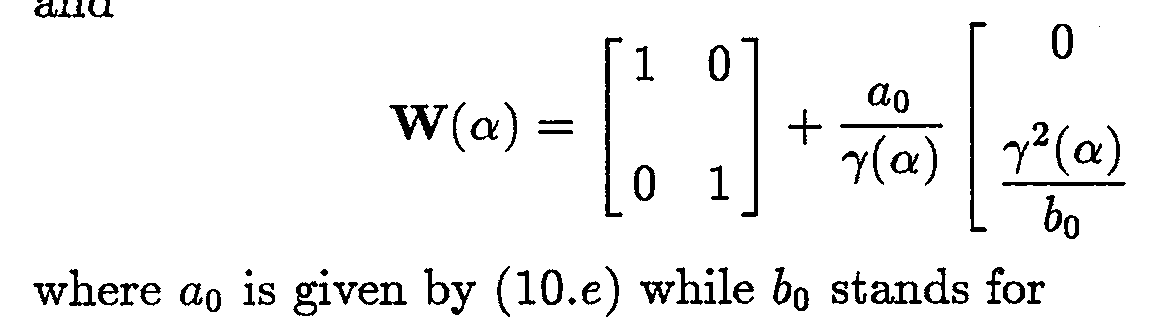
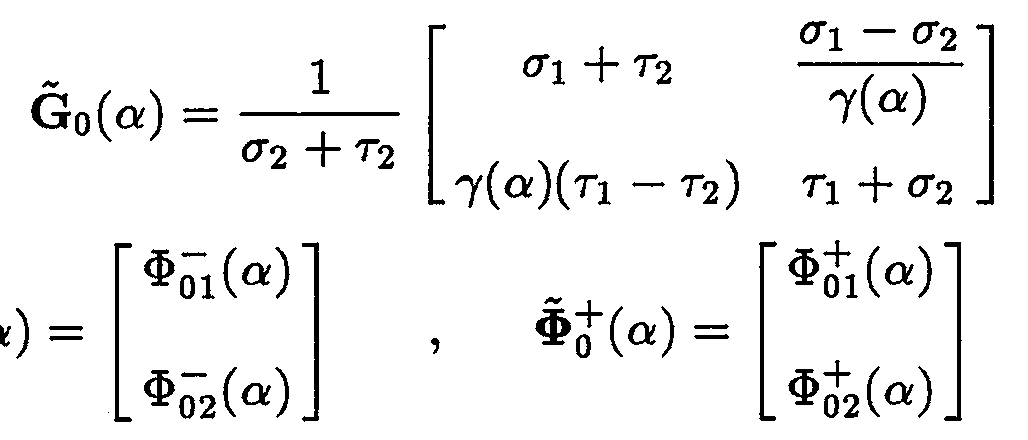
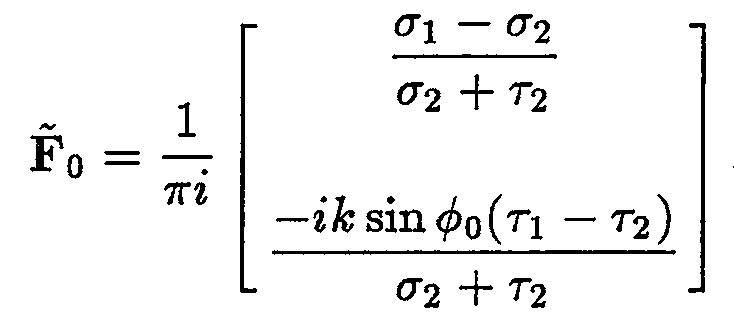
SUMMARY MULTIPLE DIFFRACTION OF A PLANE WAVE BY A MULTI-PART THIN DIELECTRIC SLAB 1. Introduction The present work deals with the multiple diffraction of a plane elec tromagnetic wave by a multi-part thin dielectric slab. The aim is to reveal the mechanism of the excitation of the second order terms between two edges. After simulating the dielectric slab by a material sheet with appropriate boundary conditions, the problem is reduced to the solution of a "matrix Wiener-Hopf equation" which can be treated by using the Daniele-Khrapkov method. By considering this result in the three-part dielectric plane problem one gets the terms up to the second order. 2. Formulation of The Two-Part Dielectric Plane Problem The basic geometrical configuration considered in the present paper is shown in figure- la. The problem consists in studying the plane wave diffraction by the junction between the thin dielectric slabs. In order to this end one considers an equivalent two-part material plane illuminated by a linearly polarized plane wave u*(x, y) (see figure-lb), namely: uifx y\ - e-ik(x cos o+y sin (j>0) 0<0 0 (3.c) - uT{x, +0) - r2 -z-uT(x, -0) = 0, x > 0 (3. d) dy dy o, j = 1,2 (4.c) {K j/(k/j.j sin 0) for TMZ case (4.d) )Cj/(ksj sin o) for Ti?2 case. E one writes uT(x,y) = uu(x,y) + u°{x,y), (5) where «u(x, y), signifies the "unperturbed field" which would be observed if the whole plane y = 0 in figure- la was occupied by a homogeneous slab with parameter (£2,^25*2) while u°(x,y) represents the effect of the material discontinuity resulting from the fact that the actual dielectric layer for {y = 0, x < 0} is characterized by (eı,/fı,tı). It follows from the definition of uu(x, y) that u^x^ + Rie-W*T5**-»*T^, y>0 uu(x,y)={ (6) me-ik(x cos (j>0+y sın M V<0 Vİİ where with andwhere İ22 and T2 are the reflection and transmission coefficients, respec tively: R2 = fl^H, 2İ--H-. (7.a,b) &2+T2 CT2+T2 As to the field u°(x,y), it satisfies also the Helmholtz equation (2) and has an integral representation as follows: fA0(a)e-^a^-iaxda ; y > 0 A*, *) = 4 j- B0(a)e^y-iaxda ; y < 0 c (8.a) with 7(a) = V"2 - k2. (8.6) The square-root function in (8.6) is defined in the complex a-plane cut as shown in figure-2 such that 7(0) = - ik. Im(a) k / kcos0o. - V Re ( a) 0 -? V Figure-2 Branch-cuts and the integration fine in the complex a-plane The integration fine £ in (8.a) is the infinitely long straight line shown in figure-2. The coefficients AQ(a) and B0(a) in (8.a) are to be deter mined with the aid of boundary conditions in (3. a, 6, c, d) which can also be written explicitely as follows: u°{x,+0)-(t1u0(x,-0) = ~2- - ?le-ifc*c°s^ ; x < 0 02 + T2 -u°(x,+0) - Ti-- u°(x,- 0) = 2iksmo e oy oy cr2 + r2 2 1 - ifci COS ^0 « °(x,+0)-o-2u0(a;,-0) = 0 ; a: > 0 - u°(a;,+0)-r2~u0(x,-0) = 0 ; a; > 0. (9.a) x <0 (9.6) (9.c) (9.d) In order to obtain a unique solution to the problem (8.a, 6) and (9. a, 6, c, e?), it is also necessary to take into account the edge condition. By using Meixner's method, it is shown that *°(*.°> = -^+°(>) as x -* 0 (lO.a) Vlllwhere with and with \0=60\0 (10.6) Ao= 1 logf^- ^) (lO.c) So = sign I arg f ° J J- (10-d) (ffı -q-2)(ri -r2),. ao = l/(ffl+r2)(n+.2)- (1°-e) By substituting first (8. a) into (9. a, 6, c, eQ and then inverting the resulting integral equations one gets A0(a) - fflB0(a) = *+ (o) + -. (°"* " ^ -r (ll.o) 7re (o-2 + t2)(ol - k cos 0O ) -7(a) [A0(a) + riBo(o)] = $&(a) - Efesin <£0 (n " ^ 7T (o) (11.6) ilo(a) - 02#o(a) = $oi(a) (1Lc) -7(a) [A0{a) + r2B0(a)} = $^(a), (ll.d) where <&*x(a) and $^2(0;) are certain unknown functions. What is known about these functions is that $01(0;) an(^ $02 (a) are regular functions of a in the half-plane Im(a) > Im(-k) while $^(0;) and $^2(a;) are regular in Im(a) < Jm(&cos^>o)- On the other hand from the edge condition in (10. a), one concludes *± (a) = O (a"*0) (12.a) $ 01 (a) = O (a-*0-1) (12.6) and *+(«) = fl^£İ_î_ + O fa-^"-1) (12.c) 00 in their respective region of regularity. The elimination of Ao{a) and Bo(a) between (11. a, 6, c,d) yields a matrix Wiener- Hopf equation from which we shall derive the expressions of #^(a); namely: G.(«)*t-(a) = *f(a) + j-L (13.a) ixwith Ğo(a) *5"(«) = and cr2 +T2 _$o~2(°0. F - X in o"l +t2 0"! - (72 7(a).7(a)(rı-r2) n + 00 in the upper and lower half-planes, respectively. Although the Wiener- Hopf factorization of an arbitrary matrix still remains at present an open problem, the kernel matrix Go (a) given in (13. b) belongs to class for which the Wiener-Hopf factorization can be accomplished through the Daniele- Khrapkov method. Indeed, if one writes G0(a) = C0W(a) with Cn = and W(a) = er2 + r2 1 0 0 1 + Im{-k) and Im{a) < Im(k), respectively. The application of the standard Wiener-Hopf technique enables one to write the solution of (26. a) as *?(*) *fi(«) ^[V+Ca)]-1 î+(a) + P!(a) (27.o) where V+(a) - (1 - a\) 2\l/4 coshxi(a) 7(a)sinhxi(a) 6isinhxi(«) 7(a) coshxi(oO (27.5) with _ /(03 -qr2)(T3 -r2) V (°3 + T2)(r3 +cr2) 61 '(0-3 -o^Xts +0-2) (o-3 +r2)(r3 -r2) and while a Xı(a) = -i^i arccos - k 1 /1-ai 2717 V 1 + a\ (27. c, d) (27.e) (27./) The term Pi (a) appearing in (27.a) is a yet unknown constant matrix of the form Pı(«)=Pı \ (28) resulting from the application of Liouville's theorem during the Wiener- Hopf procedure. And also, in (26. a) the expression I* (a) is given by I+(a) = e-in/4 [ClV-(-Jb)]_1 (^ ~ ff*)®0l(~k) e«"*f 27r(a + fe) ( /. (30) By proceeding as in the previous section one finds that Pi = £(a + k)I+(a). (31) Aoq{oc) =- (To r2 coshxi(a;) + - sinhxi(a) 0\ #(«) From (25.a, 5) and (27. a) we get eftt*(l - a\ )~^4 (ö2 + T2) 7-r [r26i sinhxi(a) + er2 coshxi(a)] [i«(a) + pi] \ (32.a) and #oq(o0 eiQ'(l - a?)"1/* - cosh xi (a) + - sinh xi (a) °i #(«) (0*2 +7"2) + -rr [61 sinhxi(a) - coshxi(a)] [j£(a) + pi] 1 (32.5) Since Aoq(oc) and Boq(ch) are now completely determined, the doubly diffracted field by the junction Q can easily be determined by evaluating (24) through the saddle-point technique to give uOQ{r,il>)~yj2^e~T1* where Si(tp,o) =ksmij) h-afy1/4 eikr (Si(?Mo) ; ^?(0,tt) () - i- sinAi(7r - V>) "1 ?Tn(- kcostp) - [r2fei sinAi(7r - r/>) + ecr2 cos Ai(7r - ^>)] [.^i2(- kcostp) +pi] (33.6) and ^(Vs^o) =A;sin'0 cos Aı (ît - ^>) - - sin Aı (ît - ^) Iii(-kcostp) - [61 sinAi(7r - if)) + icos Ai(7r - t/>)] [l^2(- kcostj)) +pi] (33.c) XV
Author
Dr. Ali Alkumru

How to Cite
Ali Alkumru (Doctorate thesis). Multiple diffraction of a plane wave by a multi-part thin dielectric slab, 1994, Istanbul Technical University.
Figures & Images (95)
License
Tüm Hakları Saklıdır
This work is shared under the specified license terms.
More theses from Istanbul Technical University
- Investigation Of Stretching Effect With Mixed Finite Element Formulations For Laminated Beams And Plates(2023)
- Classification of anemia using data mining methods: An application(2015)
- Removal and recovery of platinum group metals through anode slimes of moebius electrolysis(2015)
- A study of design approaches to Istanbul's city halls based on space syntax theory(2015)
- A II. German Empire project: From Kaiser Wilhelm Monument to German fountain(2015)
- Uzaktan algılama verilerinin yersel ölçümlerle entegrasyonu ile toprak tuzluluk haritalaması; Aşağı Seyhan Ovası, Adana, Türkiye(2015)