
Determination of catalytic effects od Pd and Pd based electrodes in electrooxidation of glycerol
1993
0 views
0 downloads
Advisor: Prof. Dr. Figen Kadırgan
Abstract (EN)
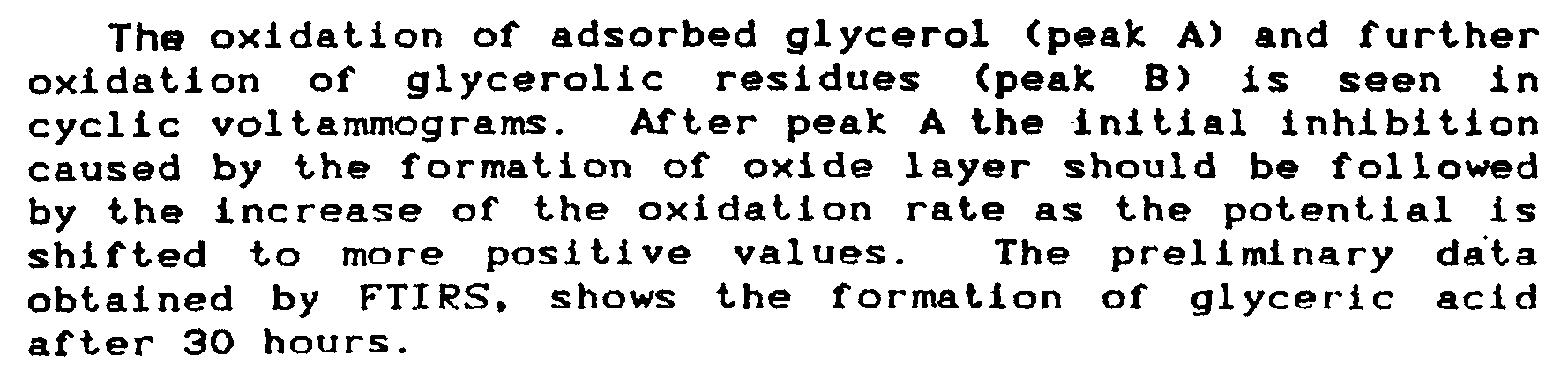
The most of the energy consumed today is being obtained from the thermal combustion of coal, oil, and natural gas. These hydrocarbon fossil fuels which occured many millions of years ago are limited. This fact constitutes a starting point for thinking about the world energy situation. The other point is also the pollution of the atmosphere with products from internal -combustion reactions its possible effect on world temperature and sea levels. As an alternating energy supplies, the development and construction of electrochemical generators have begun since 1960's. Many types of fuel cells have been described in the literature. Among fuels already used in fuel cells, besides hydrogen, are many hydrocarbons, several lower alcohols, hydrazine, and ammonia. These fuels are generally used as anodically reacting materials in combination with an oxygen cathode. Single organic compounds, such as methanol, formaldehyde, formic acid, ethylene glycol have several advantages with regard to their use as fuels. They are non-toxic, easy to store and handle and they posses & high energy density as potential fuels. They can be generated from the biomass. Because of their simple structure, they should have the simplest and most straighforward reaction mechanisms of all the possible organic fuels. Glycerol is a potential fuel of practical interest whose electrooxidation has not been studied in detail although interest in this reaction is growing because of the possibilities to obtain it from the biomass extract. It is a complex reaction whose mechanism is far from being^ understood. The aim of this work is to obtain new data on glycerol oxidation on the palladium electrode. All the electrochemical measurements were made using a doublewall thermostated cell. The working electrode was a microsphere obtained by melting a 0.5 mm diameter wire of an high purity metal. viiiThe counter electrode was made a platinum wire with cylindrical geometry. The reference electrode was a Hg/HgSCU In the third part of our research the electrooxidation of glycerol was studied in alkaline medium on platinum- palladium codeposits were prepared by electrodeposition at 25°C and a controlled potential of 0.0S V vs. SCEThe alloy electrodes were prepared by using some different mixtures of 1 M hydrochloric acid solution i % chloroplatinic acid and 1 X palladium chloride and with different surface compositions alloys were obtained. These alloys costitute a continuous series of solid solutions which allows us to vary continuously the bulk composition and therefore the surface composition in the whole composition range. Although platinum and palladium have very similar properties (same group of the periodic table» same fee crystal structure, similar atomic size), they have a different electrochemical behaviour. Therefore, a systematic study of these alloys may be interesting in order to better understand the electrocatalytic mechanism of the glycerol oxidation. The cathodic potential limit of the sweep for palladium and platinum-palladium electrodes has been chosen to be more anodic than the hydrogen adsorption region in order to avoid any hydrogen absorption, which would change the electrode structure. Surface areas of pure metals and alloyed metals are evaluated from the quantity of electricity involved in the reduction of the oxygen layer previously adsorbed during the anodic sweep. Surface composition is estimated from the reduction peak potential of the oxygen layer adsorbed. These potentials are intermediate on alloy electrodes between those of pure metals. The surface composition on the alloy co-deposits is very often far from the bulk composition. The atomic palladium content is generally higher for the bulk alloy than for the surface. This could be due to a preferential chemical or electrochemical dissolution of palladium on the surface in alkaline media. The electrocatalytic activity of alloy electrodes for a certain surface composition is higher than that of pure metals. The anodic and cathodic sweeps are irreversible in the case of palladium-palladium electrodes, however these are superimposed on both platinum-platinum and alloy electrodes. The electrocatalytic activity of pure metal electrodes and alloy electrodes for the oxidation of glycerol has been systematically investigated in 0.1 M glycerol -0.1 M NaOH. xiAnalysis of the voltammograms in terms of Tafel plots has been made. These Tafel plots lead to relatively good straight lines. The equilibrium potential of glycerol oxidation is calculated from thermodynamic data. The extrapolation of Tafel plots to equilibrium potential gives the exchange current density. By this quantity great selectivity can be achieved through the choice of alloy electrodes, since the glycerol concentration is kept constant. In alkaline medium, the Tafel zone shows an average value an=0.5 When plotted vs the alloy surface composition the exchange current densities pass through a maximum at about 33 Vi atomic of palladium. This synergistic effect is relatively important since the exchange current densities obtained are greater than those for pure metals. In the present state of our knowledge and investigation it is hard to explain quantitatively the origin of the synergistic effect during the electrooxidation of glycerol. The first explanation is modification of the electronic properties. Since platinum and palladium have very similar electronic properties and the Fermi level does not change very much in alloy, this explanation may not be involved in the interpretatin of such effects. According to the second explanation, each atom playing a definite role in the overall oxidation process. The platinum-palladium alloy with higher palladium content shows less catalytic activity than platinum electrodes because of the inactivity of the palladium sites. At the end of these studies we were reached some important points. These fundamental results will be a light of with glycerol fuel cells.
Author
Dr. Gülcemal Yıldız

How to Cite
Gülcemal Yıldız (Doctorate thesis). Determination of catalytic effects od Pd and Pd based electrodes in electrooxidation of glycerol, 1993, Istanbul Technical University.
Figures & Images (177)
License
Tüm Hakları Saklıdır
This work is shared under the specified license terms.
More theses from Istanbul Technical University
- Investigation Of Stretching Effect With Mixed Finite Element Formulations For Laminated Beams And Plates(2023)
- Classification of anemia using data mining methods: An application(2015)
- Removal and recovery of platinum group metals through anode slimes of moebius electrolysis(2015)
- A study of design approaches to Istanbul's city halls based on space syntax theory(2015)
- A II. German Empire project: From Kaiser Wilhelm Monument to German fountain(2015)
- Uzaktan algılama verilerinin yersel ölçümlerle entegrasyonu ile toprak tuzluluk haritalaması; Aşağı Seyhan Ovası, Adana, Türkiye(2015)