
The quantum matrix groups and q-oscillators
1992
0 views
0 downloads
Advisor: Prof. Dr. Metin Arık
Abstract (EN)
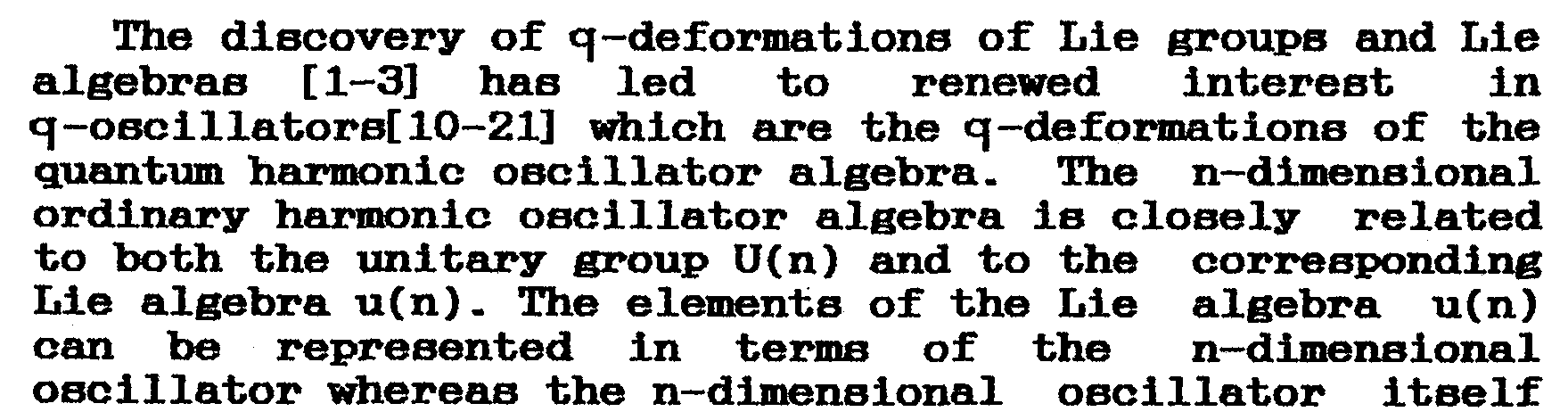
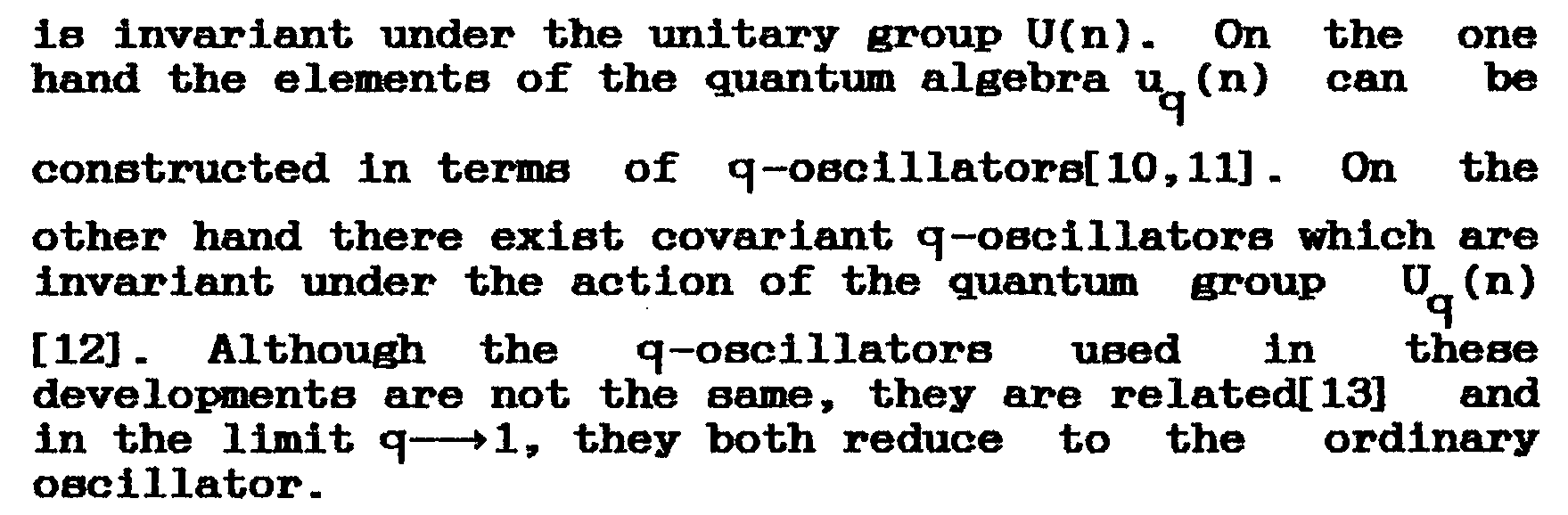
Quantum groups were introduced by V.DRINFELD[1]. They appear as the underlying mathematical structure in several contexts: Quantum inverse scattering methods, rational conformal field theory and the theory of braids. These constructs may be viewed as matrix groups with non-commutative elements obeying sets of bilinear product relations[2,3]. The sufficient condition for the associativity of the algebras turns out to be the Yang- Baxter equation[4], the analogue for the Jacobl identity for quantum groups[5]. A characteristic property of the quantum groups is that the generators, which are the mapping from the group to the basic matrix representation in the limit cj - »1, are not commuting. In the viewpoint considered by Manin [6] a quantum group is identified with the endomorphisms acting on spaces whose elements are non-commuting coordinates. In the matrix representations of the endomorphisms [7-9], the commutation relations for the space coordinates generate the commutation relations the matrix elements have to satisfy. The minimal sets of relations imposed by Manin' s construction turn out to be same as that of bilinear relations specified by an ^-matrix satisfying the Yang-Baxter relatione 4]. Other properties of quantum 2x2-ma.tr ices have been investigated by Vokos et al [8]. They show that the n-th power of the matrix A corresponds to the n-th power of the deformation parameter q and that it is possible to express a quantum 2x2-matrlx A as an exponential of another matrix M whose entries obey very simple, q- independent commutation relations. One of these was also proven by Corrigan et al[9]. The discovery of q -deformations of Lie groups and Lie algebras [1-3] has led to renewed interest in q-oscillators[ 10-21] which are the q -deformations of the quantum harmonic oscillator algebra. The n-dimensional ordinary harmonic oscillator algebra is closely related to both the unitary group U(n) and to the corresponding Lie algebra u(n). The elements of the Lie algebra u(n) can be represented in terms of the n-dimensional oscillator whereas the n-dimensional oscillator itself -v-is invariant under the unitary group U(n). On the one hand the elements of the quantum algebra u (n) can be constructed in terms of q-oscillators[10,ll]. On the other hand there exist covariant cj -oscillators which are invariant under the action of the quantum group U (n) [12]. Although the q -oscillators used in these developments are not the same, they are related! 13] and in the limit q - >1, they both reduce to the ordinary oscillator. In this work we study the quantum group GL (3,C),i.e. the quantum group of 3x3-matrices A=(a.. ), whose elements obey certain q -dependent commutation relations. We show that the quantum 3x3-matrices (naturally nxn-matrices) can not be expressed as an exponential of a matrix whose elements obey q- independent commutation relations. Contrary to 2x2-quantum matrices the n-th power of a quantum 3x3-matrlx A does not correspond to the n-th power of the deformation parameter q. We obtain the relations satisfied between the matrix elements of a quantum matrix A and the quantum cofactor of the matrix elements of A. For example, aiA(Aik} = q VAlk)aid ' İ=1 and *** ' and aidVAik} " * VAUk}ald = "^ ~ q_1) ^q^lk^ld for i = 2 and i£k, j'-'k, i1, and aiA(Aik} = <* ^q^ik^id. i=:3 and di-k where ^«(A^j) denotes the quantum cofactor of the matrix element a.. of quantum 3x3-matrix A. Using these relations, we obtain a new form giving the quantum determinant of a quantum nxn-matrix A. Next, we considered another quantum 3x3-matrix B=(b.. ) whose elements commute with the elements of the -vi-quantum 3x3-matrix A=(a..) : aidbkl = bklaiJ ' V ^d.k.l. We study properties of the product matrix C = AB = (c±d) and show that its matrix elements satisfy the same q commutation relations that the elements of the quantum matrix A satisfy. For each quaternion helH, written as n = «0 + alel + *2e2 + ^3 ' define <£(h) = QeMgCC) by [an + a1i a,, + a"i1. i4 - >el -a2 + agi aQ - a^J where, for a,ft = 1,2,3 aote^5 " ef3aa and.: = -i- We introduce the deformation of the quaternion algebra (H using the quantum matrix theory and we interpret as q -quaternions. Using q -quaternions we construct quaternionic quantum groups as q - »1 reduce to ordinary quaternionic matrix groups. Next, we discuss the paremetrization of quantum groups in terms of independent operators. We find that this consideration leads to the paremetrization of SÜ (2) in terms of a q -oscillator plus a commuting -vii-phase. Indeed, if ?C 3- A = | | (A) = 1 A = L sb* a* J and aa +qbb=l=aa+bb and so * 2 *, 2 aa -qaa=l-q. * Thus a rescaling of creation operator a and of the annihilation operator a by ?* (1 - q ) ' a a * (1 - q ) ' a will give * 2 *, aa - q a a = 1. This is the one dimensional q -oscillator. The commuting phase is naturally identified with the subgroup 0(1) and the remaining quantum coset SU (2)/U(l) consists of a q-oscillator - -viii-For special unitary quantum groups SU (3), the analogous construction results In the quantum coset SU (3)/U (2) being identified with the 2-dimensional q -oscillator. Generally, we will show that the unitary quantum group Ü (n) can itself be constructed in terms of n(n-l)/2 q -oscillators and n commuting phases corresponding to the (U(l))n subgroup of U (n). We will show that the quantum group coseta SU (n)/U (n-1) can be identified with (n-1) cj -oscillators, provided that the normalization of the oscillators are chosen such that in the q - >1 limit the oscillator creation and annihilation operators commute and give a c-number. So the unitary quantum group U (n) in this limit reduces to the classical unitary group U(n) of nxn-matrices of c-numbers. -ix-
Author
Dr. Salih Çelik

How to Cite
Salih Çelik (Doctorate thesis). The quantum matrix groups and q-oscillators, 1992, Istanbul Technical University.
Figures & Images (91)
License
Tüm Hakları Saklıdır
This work is shared under the specified license terms.
More theses from Istanbul Technical University
- Investigation Of Stretching Effect With Mixed Finite Element Formulations For Laminated Beams And Plates(2023)
- Classification of anemia using data mining methods: An application(2015)
- Removal and recovery of platinum group metals through anode slimes of moebius electrolysis(2015)
- A study of design approaches to Istanbul's city halls based on space syntax theory(2015)
- A II. German Empire project: From Kaiser Wilhelm Monument to German fountain(2015)
- Uzaktan algılama verilerinin yersel ölçümlerle entegrasyonu ile toprak tuzluluk haritalaması; Aşağı Seyhan Ovası, Adana, Türkiye(2015)