
Production of saffil (S-AlzO3) fibre reinforced Zinc-Aluminum Alloy (ZA12) matrix composites using infiltration technique and study of their properties
1993
0 views
0 downloads
Advisor: Doç.dr. Mehmet Durman
Abstract (EN)
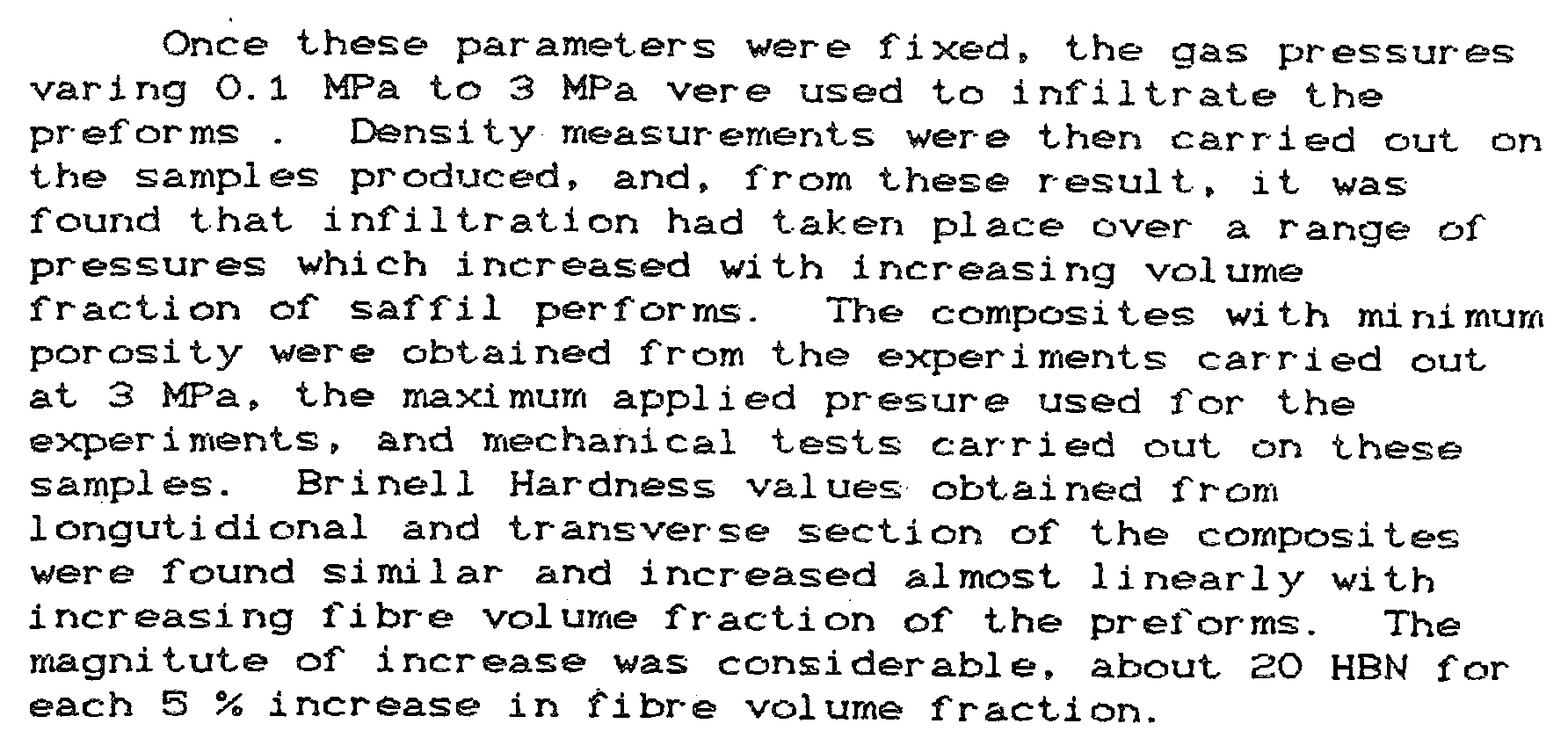
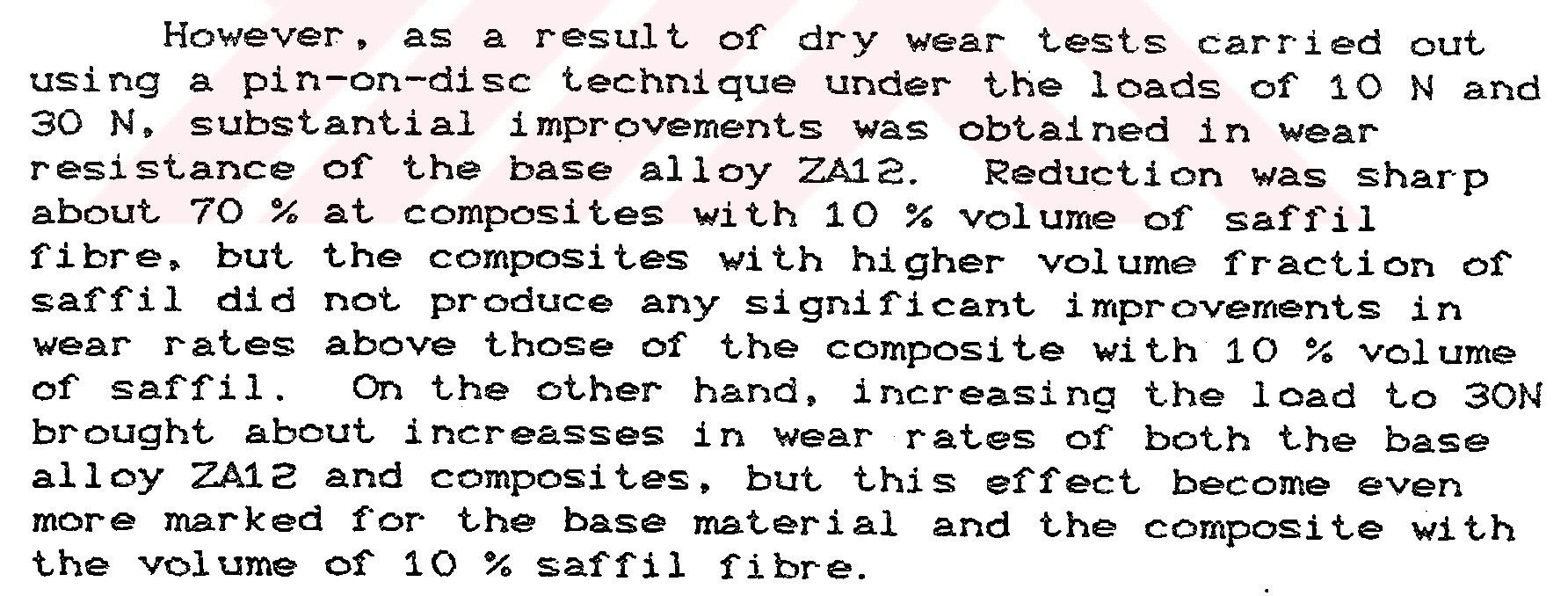
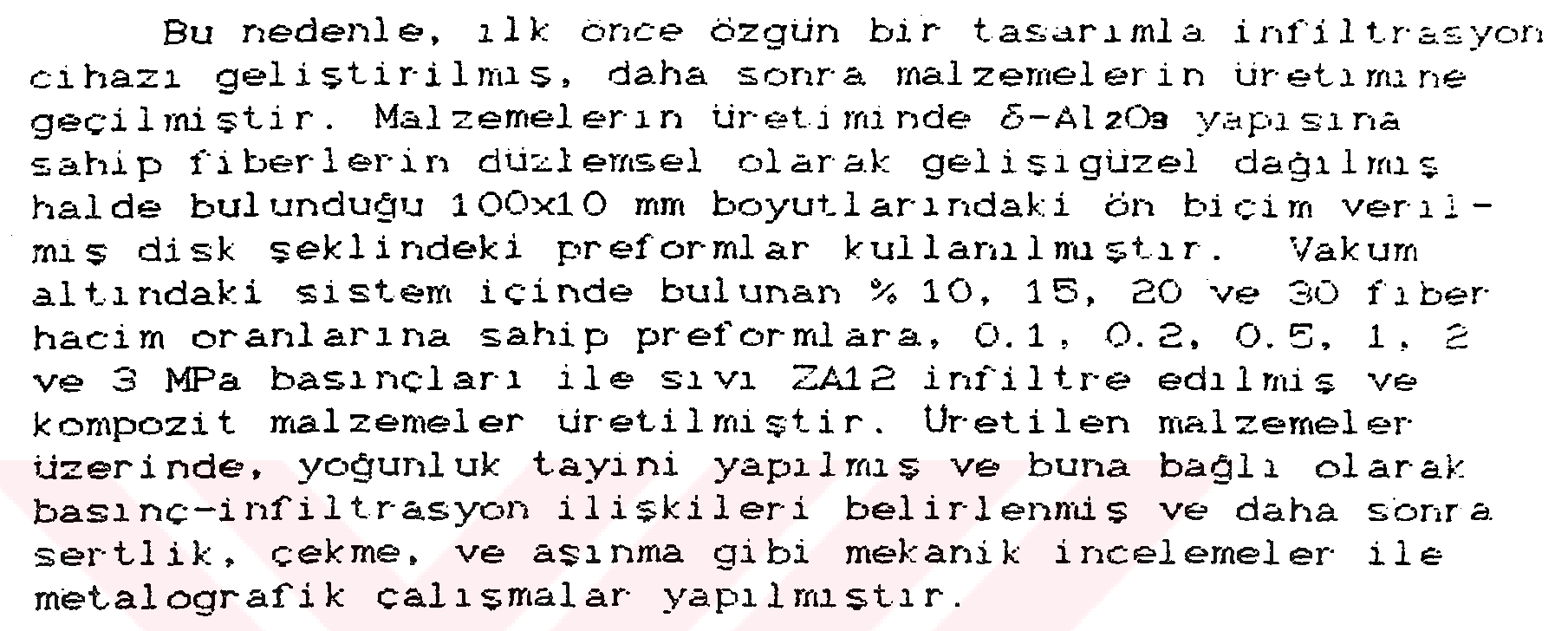
PRODUCTION OF SAFFÎL Co-AlzOa) FİBRE REINFORCED ZINC- AI.UMÎNUM ALLOY CZA123 MATRIX COMPOSITES USİNG INFILTRATION TECHNIQUE AND STUDY OF THEIR PROPERTIES SUMMARY In recent years, there has been an enormous interest in metal matrix composites (MMCs > because of their attrac tive physical and mechanical properties, such as high specific modulus, strength, and retention of properties at moderately elevated high temperatures. MMCs combine metal i c properties (ductility and toughness > with ceramic properties (high strength and high rnodulus> leading to greater strength in shear and compression and higher service teperature capabilities. Interest in MMCs for aerospace, automotive and other structural applications has increased over the last five years as a result of availability of relatively inexpensive reinforcement, and the development of various processing routes which result in reproducible rnicrostructures and properties. MMCs encompasses a very broad class of materials which can be subdivided into three main groups; particulate, whisker or short fibre and continuous fibre reinforced metals. Although MMCs reinforced with continuous fibre provides the greatest improvement in properties, the main thrust of the commercialisation of metal composites has been with the use of particulate reinforcement. This is due mainly to the relative ease of production of particulate reinforced MMCs compared with the difficulty in processing continuous fibre composites. For the production of particulate reinforced composite it is relatively easy to process large quantities of the material by conventional manufacturing methods, such as casting and extrusion. The particles are mixed with the molten aluminum and the composite material can then be processed by conventional means. With these production methods the volume fraction is limited to approximately 20% due to increase of the metal viscosity that occurs on the addition of the reinforcing particles.Whisker and short fibre composites can be manufactured either by incorporation of the reinforcement material into the melt or by the production of a fibre preform which can then be infiltrated with molten metal, as in squeeze casting and pressure infiltration process. In melt mixing the level of reinforcement is once again restricted in the liquid metal by the increase in viscosity. In the infiltration of preforms it is restricted as a result of the mabilty of randomly oriented fibres to achive a packing density higher than O. 35 volume fraction. Other manufacturing processes that are used for discontinuous and particulate reinforcement include powder metallurgy and plasma cospray deposition. Both have considerable drawbacks. The mechanical forces involved during powder processing result in consi.dera.ble fibre damage and the plasma cospray deposition has a low productivity and is severely limited by shape/size consi der ati ons. There are two main routes for production of short fibre MMCs. These are squeeze casting and pressure infiltration process. Squeeze casting was the first manufacturing method that gave the possibility of a one shot process combined with high producibility rates. The main drawback of this process is that the engineering required to cope with the high process pressures involved result in a size and shape limitation and the mechanical forces involved result in severe fibre damage. Pressure infiltration process is also a route for high qual typroduction of net shape components using gas pressure to force molten metal into a previouslly manufactured preform. The advantage of this process over squeeze casting is that die cavity and the pressure vessel can be evacuated, which greatly increases the quality of material produced. The development of alumina based short fibre such as I.C.I. 's saffil fibre and its incorporation in aluminum alloys by these techniques has lead to its industrial application in areas where high temperature, strength and resistance to thermal fatique are important criteria. Such fibres are connected to solid preforms by suspansion in an aqueous medium, which indudes a binder such as sodium silicate, corpareted by infiltration and pressing or centr i fuji ng followed by drying and firing. These fibres in the preform are usually two dimensional andrandom in orientation. These preforms can be located in a die cavity for selective reinforcement specific areas. The most carnrnon metal matrix material used in industrial application of MMCs is aluminum alloys, although considerable interest is also being shown in titanium and magnesium and, to lesser extent, copper, lead and iron. The concentration of effort on aluminum alloys stems, from its uniqe combination of good corossion resistance, low density and excellent mechanical properties However new materials, such as new zinc- aluminum based ZA alloys, with superior properties to the above communly used alloys in many aspect would also be a good substitutes as a matrix material for many applications. In wiev of these recent developments in materials industry, the objectives of this study were set as follows; to produce saf fil fibre reinforced zinc-alumi num alloy matrix composites using pressure infiltration process, to investigate casting conditions, mi crostr uç tur e and some principle mechanical properties of resultant composites Ât the first step to achive these purposes, a uniqe infiltration process with the flexibility of producing near net shape components by liquid metal infiltration of reinforcing material using gas pressures to force metal into previously manufactured preform has been developed, and saffil preforms with volume fractions of 0.10, 0.15, 0. 20, 0.30 alumina saffil fibres have been infiltrated by molten ZA12 alloy at various gas pressure from O. 1 MPa to 3 MPa. The disk shape preforms used for infiltration in this study were lOO mm in diameter by lO mm thick with two-dimensional random arrangament of saffil <5-alumina> fibres. The preforms were placed into a split die cavity cut out in the shape of the preform. The lower half of the die was connected to the molten metal reservoir by a feed tube. The both upper half of the die and pressure tank was connected to a mechanical vacum pump which allowed the die cavity and pressure tank to be vacummed prior to the infiltration and liquid metal solidified inthe die cavity. After infiltration was completed, the pressure tank and die cavity was depressurezied and infiltrated preform was taken out the split die. v: 1 nThe parameters influencing the infiltration process were ; die (preform) temperature, liquid metal temperature, applied pressure and volume fraction of saf fil fibres in the preforms. The temperature used in the process is an important parameter and may vary depending on the alloy, the type and value fraction of reinforcement being used, and the size and complexity of the compenent being produced. If the die temperature is too low, the fibre temperature will be low and this could result in solidification prior to full infiltration and porosity in the casting. High temperatures, on the other hand, result in high fibre temperatures and cause excessively long solidification times and could result in reactions occuring at the fibre/metal interface. Ability to infiltrate also depends on two other factors, the melt temperature- and pressure applied. The melt temperature has lesser effect on ability to infiltrate than the die temperature because, al tough increased melt supply more heat to the casting, the effect on viscosity above the liquids is only slight. Excessive melt temperatures result in longer solidification times, possibility of fibre/metal reaction and more rapid die erosion. Once the die and the melt temperatures are fixed to the optimum values, the other important parameters effecting the infiltration are vacum and pressure applied to the system. The evacuation of the system serves several purposes and greatly increasing the quality of materials produced. It degasses the molten metal preventing the evolutionof gas on solidification. It removes air in the die that may cause porosity and allows faster cavity full times as there is no back pressure, and therefore less resistance to metal flow through the preform. The pressure is applied to the tube of the metal reservoir, when all the main parameters metal temperature, die temperature and vacum are at the requied values, is then only the factor which should be considered for succesful infiltration. The infiltration pressure also depends on the alloy, the type and volume fraction of reinforcement and complexity of the component being produced. The pressure causes molten metal flow through the preform and increases the wettability of fibre/metal interface. It is essential to achive good mechanical contact and bonding between the fibre and matrix and to overcome any intrinsic lack of wetting.In this study, as a result of numerous pre-experi- ments caried out, the optimum die temperature and melt temperature for the infiltration of ZA12 alloy were found to be 350°C and 650 C respectively. Once these parameters were fixed, the gas pressures varing 0.1 MPa to 3 MPa vere used to infiltrate the preforms. Density measurements were then carried out on the samples produced, and, from these result, it was found that infiltration had taken place over a range of pressures which increased with increasing volume fraction of saffil performs. The composites with minimum porosity were obtained from the experiments carried out at 3 MPa, the maximum applied presure used for the experiments, and mechanical tests carried out on these samples. Brinell Hardness values obtained from longutidional and transverse section of the composites were found similar and increased almost linearly with increasing fibre volume fraction of the preforms. The magnitute of increase was considerable, about 20 HBN for each 5 % increase in fibre volume fraction. Tensile strength and elongation of the composites were found to be much lower than those of the base alloy ZA12 and the decrease was much more noticable at the composites with higher volume fraction of saffil fibres. However, as a result of dry wear tests carried out using a pin-on-disc technique under the loads of İO N and 30 N, substantial improvements was obtained in wear resistance of the base alloy ZA12. Reduction was sharp about 70 % at composites with İO 'A volume of saffil fibre, but the composites with higher volume fraction of saffil did not produce any significant improvements in wear rates above those of the composite with 10 "A, volume of saffil. On the other hand, increasing the load to 30N brought about increasses in wear rates of both the base alloy ZÂ12 and composites, but this effect become even more marked for the base material and the composite with the volume of 10 % saffil fibre.
Author
Dr. Süleyman Can Kurnaz

How to Cite
Süleyman Can Kurnaz (Master Thesis). Production of saffil (S-AlzO3) fibre reinforced Zinc-Aluminum Alloy (ZA12) matrix composites using infiltration technique and study of their properties, 1993, Istanbul Technical University.
Figures & Images (138)

Keywords
License
Tüm Hakları Saklıdır
This work is shared under the specified license terms.
More theses from Istanbul Technical University
- Investigation Of Stretching Effect With Mixed Finite Element Formulations For Laminated Beams And Plates(2023)
- Classification of anemia using data mining methods: An application(2015)
- Removal and recovery of platinum group metals through anode slimes of moebius electrolysis(2015)
- A study of design approaches to Istanbul's city halls based on space syntax theory(2015)
- A II. German Empire project: From Kaiser Wilhelm Monument to German fountain(2015)
- Uzaktan algılama verilerinin yersel ölçümlerle entegrasyonu ile toprak tuzluluk haritalaması; Aşağı Seyhan Ovası, Adana, Türkiye(2015)