
Calculating calorific value of Turkish lignites from their proximate analysis
1990
0 views
0 downloads
Advisor: Prof. Dr. Enis Kadıoğlu
Abstract (EN)
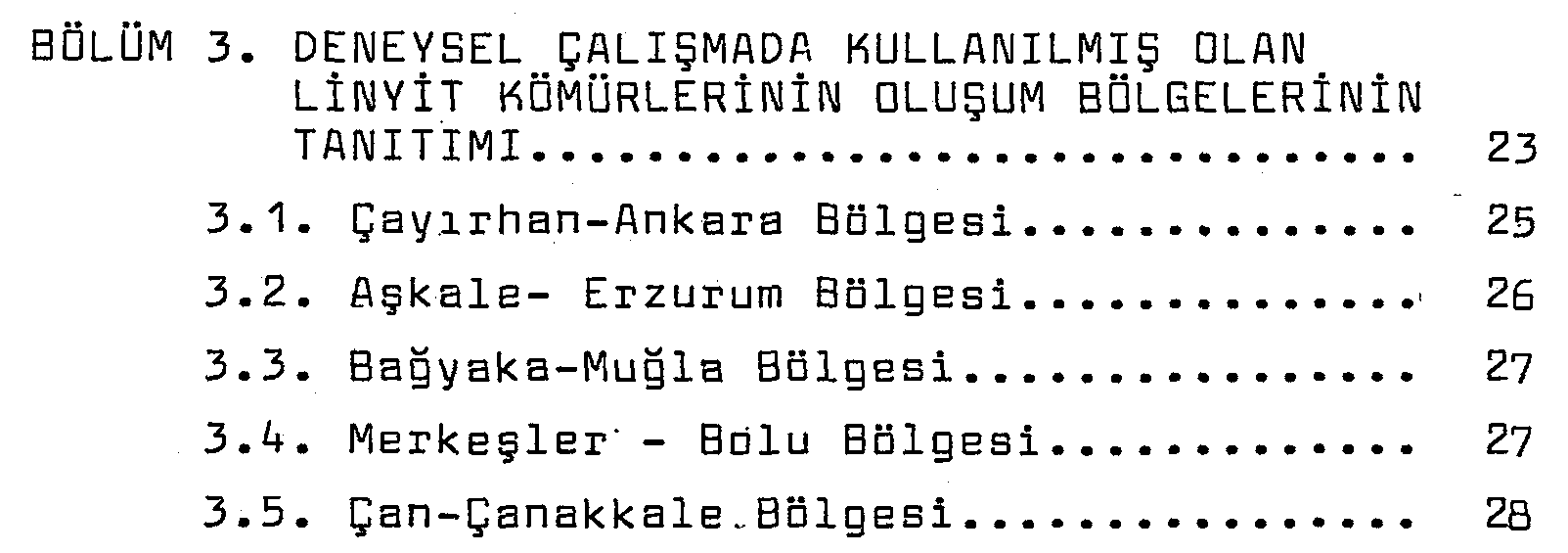
As the calorific value test is a direct measure of the energy value Df a coal it is the most significant of all the laboratory tests made in coal analysis for determining the value of coal as a fuel. The calorific value of a fuel:-is the quantity of heat which, is obtainable by>the complete combustion of unit weight of solid or liquid fuels, or unit volume of gaseous fuels. The calorific value of coal varies with the type of coal and with the amount of incombustible material mixed with the organic matter. In combustion technology interest is mainly direc ted towards the calorific value of coal. Calorific values of coals can be determined in the laboratory or calculated from their proximate and ultimate analysis. Several types of methods for the determination of calorific value of coal were introduced during the lat ter part of the nineteenth century, and for each method some special advantage was claimed. Several of these methods can be grouped as follows: 1- Measurement of reducing power of coal, 2- Combustion of coal by a solid oxidizing agent, VI i3- Combustion of coal in a stream of oxygen at constant pressure, 4- Combustion of coal in a bomb with oxygen under pressure at constant volume. 1)- Measurement of reducing power of coal: In this method the reducing power Df coal was measured by heat ing cobI with litharge and multiplying the weight of the lead button obtained by a factor. The product rep resents theoritically the reducing power of the carbon in terms Df Btu. This method has historical rather than practical interest. 2)- Combustion of coal by a solid oxidizing agent: In the Lewis Thompson calorimeter the coal sample was mixed with potassium nitrate and potassium chlorate. This mixture was ignited and immersed in water to measure the heat produced by combustion. The Parr sodium pero xide calorimeter have been used extensively for technical work. Sodium peroxide is used in this calorimeter as the oxidizing agent. 3)- Combustion of coal in a stream of oxygen at constant pressure: klith these calorimeters a current Df oxygen was conducted through a chamber where the fuel was burned at constatnt pressure. The cheief disadvan tage of this method is the likelihood of incomplete com bustion, expencially with high-ash coals. 4)- Combustion of coal in a bomb with oxygen under pressure at constant volume: The first calorimeter Df this -type was devised in 1881. As the accuracy of the oxygen-bomb calorimeter for measuring the calorific value of coal became established, improvements were ma de in the construction and operation of such calori *. meters sd that now this/type is the most accurate of any that have been used in coal calorimetry. in this method calorific values of coals are deter mined by burning a known weight in an atmosphere of oxygen, at a pressure of not less than 25 atmosphere, in a steel bomb which stands in a calorimeter vessel containing a known weight of water whose temperature may be determined accurately. The calorimeter vessel in surrounded by a jacketed enclosure to minimise interchange of heat with its surroundings. If the rise of temperature of the Vlllwater equivalent of the apparatus are accurately known, very consistent results may be obtained, provided the necessary small correction for radiation is applied. rimet coal busti ratur the p ratur sensi heat strea to di the b value state value Calorif er repr when co on (CO- e. Thi roducts e befor ble hea loss oc m in th stingui omb cal » Th "n ment of ıc v esen mple and s va of e be t lo curs e ha sh t orim ett xea alues t the tely H2D, lue i combu ing d st in in p t was he ca eter calor lisab as hea Dxid etc s no stio isch the ract te g lori by c if ic le p determine t produce ised, the.) being t realise n are not arged to hot wast ice as th ases. It fie value ailing it value" i o t en t i al d wit d by prod coole d in cool waste e pro e lat is t as d the sam heat h the b unit we ucts Df d to ro practic ed to r. Not ducts b ent hea heref or etermin gross c ore rea than th omb ight the om t e be oom only ut f t of e us ed w alar list e gr calo- of com- empe- cause tempe- is urther the ual ith if ic ic OSS The measurement of boiler efficiency for performan ce monitoring and optimization must always involve directly or indirectly some estimate of the potential heat entering the boiler. Since the direct approach to this problem requires a knowledge of the mass flaw and calorific value of the fuel both of which are difficult to measure accurately, much attention has been given to indirect methods. The price of coal is usually related to its heat content and a quick method of determining calorific value would also be useful to both seller and customers. Various, formulas have been devised and used for calculating calorific values from coal analyses. The Formulas are based on the ultimate and/or proximate analysis of coal. Early studies of the calculation of calorific value from the data of proximate analysis were reported in 1902 by Goutal, who based his formula on fixed carbon, volatile matter and a function of the moisture-and ash- free volatile matter, During the 1920s and 1930s there was a great deal of activity in devising and revising such formulas. IXCalarimetric measurements and ultimate analysis Df coal are cumbersome and require special instrumentation, whereas proximate analysis of coal can be performed with relative ease using common laboratory equipment. Hence a method that gives rapid yet accurate estimates of calorific value of coal, using only proximate analysis will be of great practical value. The purpose of this study urns to examine the re lationship between calorific value and proximate analy sis of Turkish lignites. The lignite samples used are from. 1- Çayırhan - Ankara, 2- öşkale - Erzurum, 3- Bağyaka - Muğla, k- Merkeşler- Bolu, 5- Çan - Çanakkale, 6- Dodurga - Çorum, 7- Akpınar - İstanbul, B- Çiftalan - İstanbul, 9- Gediz - Kütahya, 1ü- Ilgın - Konya, 11- Mengen - Bolu, 12- Mihalıçcık-Eskişehir, 13- Milas - Muğla, *\k- Orhaneli - Bursa, 15- Seyitömer- Kütahya, 16- Soma - Manisa, 17- Tepebaşı - Konya, 18- Tınaz - Muğla, 19- Karakaya - Tekirdağ,The volatile matter of the lignite samples varies between 24.95-55.02%, the ash content between 7.61-43.19% and the heat content betueen 14.81 MJ- 29.24 MJ. Heating values of Turkish lignites vary over a wide range among different reserves.targe fluctuations within a single reserve are also common. Several correlations are developed for estimating the heating value of Turkish lignites that employs only proximate analysis data. Lde developed correlations for estimating the heating value of Turkish lignites by making use of common labora tory analysis of coal. The calorific value of Turkish lignites has been shown to be directly related to the proximate analysis data. The proposed correlations are simple and compares favourably with the other prominet fromulas reported in the literature. Application to other 26 Turkish lignites from provious work reveals that the developed correlations can 'be used for estimating the calorific values of Turkish lignites.
Author
Dr. İlknur İskender
Institution

How to Cite
İlknur İskender (Master Thesis). Calculating calorific value of Turkish lignites from their proximate analysis, 1990, Istanbul Technical University.
Figures & Images (90)
Keywords
License
Tüm Hakları Saklıdır
This work is shared under the specified license terms.
More theses from Istanbul Technical University
- Investigation Of Stretching Effect With Mixed Finite Element Formulations For Laminated Beams And Plates(2023)
- Classification of anemia using data mining methods: An application(2015)
- Removal and recovery of platinum group metals through anode slimes of moebius electrolysis(2015)
- A study of design approaches to Istanbul's city halls based on space syntax theory(2015)
- A II. German Empire project: From Kaiser Wilhelm Monument to German fountain(2015)
- Uzaktan algılama verilerinin yersel ölçümlerle entegrasyonu ile toprak tuzluluk haritalaması; Aşağı Seyhan Ovası, Adana, Türkiye(2015)