
Petroleum in Turkey and the analysis of petroleum sector by input-output method
1993
0 views
0 downloads
Advisor: Y.doç.dr. Halil Aksu
Abstract (EN)
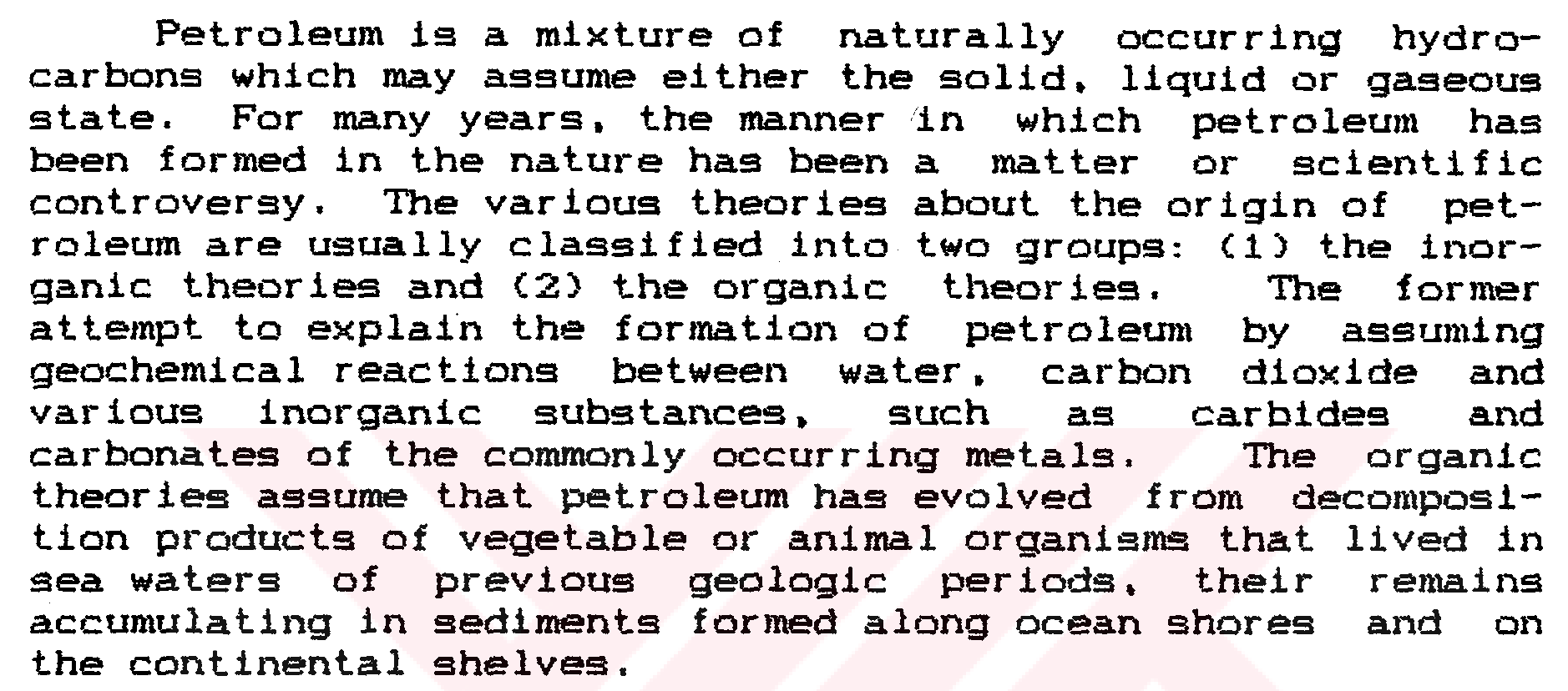
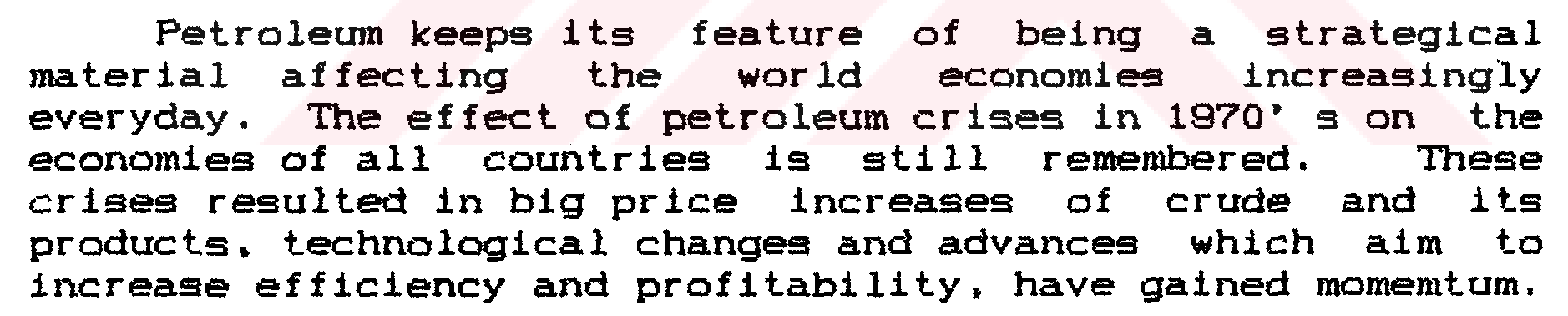
Petroleum is a mixture of naturally occurring hydro carbons which may assume either the solid, liquid or gaseous state. For many years, the manner in which petroleum has been formed in the nature has been a matter or scientific controversy. The various theories about the origin of pet roleum are usually classified into two groups: (15 the inor ganic theories and C2> the organic theories. The former attempt to explain the formation of petroleum by assuming geochemical reactions between water, carbon dioxide and various inorganic substances, such as carbides and carbonates of the commonly occurring metals. The organic theories assume that petroleum has evolved from decomposi tion products of vegetable or animal organisms that lived in sea waters of previous geologic periods, their remains accumulating in sediments formed along ocean shores and on the continental shelves. Petroleum keeps its feature of being a strategical material affecting the world economies increasingly everyday. The effect of petroleum crises in 1970* s on the economies of all countries is still remembered. These crises resulted in big price increases of crude and its products, technological changes and advances which aim to increase efficiency and profitability, have gained momemtum. Due to Gulf Crisis which turned into a war and affected the petroleum production areas in January 1991, all the world's attention converted to petroleum once again. By the effect of the Gulf Crisis on the crude oil prices, the importance of petroleum exploration and exploitation has been noticed. Primary energy consumption of the world is split between ÛECD (Organization of Economic Corporation and Deve lopment) countries with S2%, Former Soviet Union, Eastern Europe and China with 29% and developing countries with i9%. leum. In 19S0*s 27% of world energy demand were met by petro- This percentage has increased steadly and reached S3%in 1973, Nowadays, petroleum, with 38%, is the most important fuel to supply world's energy demand. Same of the developed countries don't have sufficient petroleum reservoirs, but some developing countries, espe cially Middle East countries have the richest world's petroleum reservoirs. It is claimed that the petroleum in the West Europe countries and the U.S. A are predicted to be exhausted in about 10 years, but the reservoirs in the Middle East region will have been exhausted for 100 years. At the end of 1991 total petroleum reservoirs of the world was 1000.9 billion barrels, OPEC (Organization of Petroleum Exporting Countries) countries have the two thirds of this amount. The petroleum reservoirs in the Middle East countries have the strategical importance for the developed countries, in order to survive their industries. Only Saudi Arabia, Kuwait and Iraq have the 4,0% of the known world's petroleum reservoirs. OPEC are exporting a large amount of petroleum to the developed countries. Refinery of capacity of OPEC countries is small compared with that of developed countries Total world petroleum production in 1991 was 64.8 million barrels a day while 37.4?s of this was produuced by OPEC countries. Petroleum will maintain its key position in the world economy by the years coming decades. The two big petroleum crises experienced in 1973 and 1979 are not considered as a danger nowadays. Today there are several methods to store petroleum. The improvement in the crude oil extracting methods is another factor preventing the world from new crises. The improvement which the U.S.A. provided extract petroleum and the discoveries in the Former Soviet Union, especially in Siberria and North Sea, new reservoirs found in the developing countries rescued world to be dependent on OPEC. In addition developed countries have found new techniques to use alternative energy sources and to save energy since 1970. Today the benefits of the petroleum producer countries and the petroleum consumer countries are not conflict each other. Because the petroleum is very restricted, the bad use of the reservoirs will create a bad situation for both sides. Although Turkey has adequate amount refinery capacities in order to suplly domestic demand, since its sources of crude oil is not rich enough, it is dependent on the import petroleum. XIIn 1991, 17.6 million tonnes of crude oil imported from different countries and a total of 24S7.6 million dollar was paid, Depending on the increase in the petroleum prices, the amount paid by Turkey will be increased. The relationship between crude oil import and net export is examined and Spearman's rank correlation is found as -0.866. This indicates a very strong negative relation ship between two data. It means that the more crude oil is imported, the less net export is occured. It can be said that less import of crude oil will have a positive effect on the balance payment. Turkey's need for a more diverse range of energy sources is revealed in its 1991 primary energy consumption CPEC) figures. Total PEC of 49.7 million tonnes of oil equivalent was split between oil (contributing 44.3%}, coal (45.3%), gas C7.6%> and hydro-electric power C2.S%>. Most of the coal is indigenous and of low grade, while local oil production only provided 90 000 barrels per day towards demand of 463 000 barrels per day. With the Iraqi transit line closed and no transit fees coming in» Turkey has turned to spot market for most of its oil needs. The break-up of the Soviet Union is likely to benefit Turkey more than most other countries. It is possible to realise projects for the movement of oil and gas to Europe from up to seven or eight countries» via Turkey. The potential rewards of transit fees and low-cost gas and oil supplies is highly attractive for Turkey. Econometric models can be used to forecast changes in demand in one sector, but such models seldom have the detail necessary to assess the impacts of those changes on other sectors. But modern economic systems are highly interrela ted. Changes in demand in one sector of the economy can have significant impacts on demand in other sectors. Some of these impacts are immediate and obvious. For example, steel, rubber» glass, and plastics are all important inputs in the production of motor vehicles. Thus an increase in the demand for automobiles would cause an increase in the demand for those four products. A possible crisis in one or more sectors may reflect their problems to the economy and therefore the economy may be driven into a stagflation or bottleneck period. It can be said that all the economic activities are the composition of the sectoral activities. XllInput-Output analysis is a useful technique for sorting out and quantifying seetor-by-sector impacts. This approach captures not only the direct effects but also related impacts in other parts of the economy. Input-Output analysis is based on a table i Inter industrial Transaction Table) that indicates historic patterns of purchases and sales between industries. Data for this table are usually generated from surveying a sample of firms. The rows of table show the disposition of each sector's output. The columns of table indicate uses of revenues by each of the sectors. Sales between sectors are called intermediate sales because they represent output that is used as inputs for making products sold to consumers. The elements of the table indicating intermediate sales and purchases are of particular interest for input-output analysis. Together, they make up the transaction matrix of the model. If each element in a column of the transaction matrix is divided by the total sales of that sector's product, the result is the Direct Requirements matrix i A) of an input-output model. The elements of each column of the direct requirements matrix can be interpreted as indicating the immediate or direct change in revenue for a sector gene rated by a i unit change in demand for the product of the sector represented by the column. The direct requirements matrix shows the immediate or direct impact of changes in demand in one sector. But the elements of this matrix do not incorporate secondary and other impacts. To take into account secondary impacts of changes in demand. input-output analysis requires computation of a Direct and Indirect Requirements Matrix. Direct and Indirect Requirements Matrix conventionally is designed by the notation CI-A)~ and called as Leontief Inverse Matrix, where A is the direct requirements matrix, I is the identity matrix and the exponent denotes the inverse of a matrix. The Leontief Inverse Matrix has a straightforward interpretation. The elements of each column indicate the change in total demand in each sector that would result from a 1 unit change in final demand for the sector designated by the column. xmThe Leontief Matrix can be used to forecast sector-by- sector impacts of changes in final demands. If total output of industry i, consistent with the final demands for all other industries products (Yi), is X; x.= <:i-A>~1y The construction of input-output models is a vsry expensive and lime consuming task. The major value of input-output analysis is that it takes into account inter relationship between sectors, However, the approach has limitations in addition to its high cost. A fundamental problem is that input-output forecasts are based on ratios that are assumed to be fixed. This assumption may not be v&ry realistic in situation where rapid technological change is occurring. Interindustrial Transaction Tables are the most useful tools that show the sectoral transactions in an economy. In this analysis 1983 Interindustrial Transaction Tables of Turkey prepared by the State Institute of Statistics in 1989 are used. The analysis mostly concentrated on the petroleum sector's relations with other sectors in the economy. In the transaction matrix table an interesting point leu» refining sector is that this sector supplies inputs to approximately all the other sectors. It can also be seen in the Leontief Inverse Matris which shows the Forward and Backward Linkages in &v&ry sec tor, that petroleum refining sector has the highest Forward Linkages Effect among 64 sectors. It is comprehensible that the Forward Linkage Effect of petroleum refining sector is highest because this sector provides inputs to almost every sectors. As a developing country, the importance of petroleum sector in Turkey can not be ignored. Petroleum has a high relations with other sectors so that problems with this sector will cause the economy to go into stagflation or bottleneck period. In other explanation, petroleum sector has a vital importance in the economy.
Author
Dr. Orhan Çınar

How to Cite
Orhan Çınar (Master Thesis). Petroleum in Turkey and the analysis of petroleum sector by input-output method, 1993, Istanbul Technical University.
Figures & Images (146)


Keywords
License
Tüm Hakları Saklıdır
This work is shared under the specified license terms.
More theses from Istanbul Technical University
- Investigation Of Stretching Effect With Mixed Finite Element Formulations For Laminated Beams And Plates(2023)
- Classification of anemia using data mining methods: An application(2015)
- Removal and recovery of platinum group metals through anode slimes of moebius electrolysis(2015)
- A study of design approaches to Istanbul's city halls based on space syntax theory(2015)
- A II. German Empire project: From Kaiser Wilhelm Monument to German fountain(2015)
- Uzaktan algılama verilerinin yersel ölçümlerle entegrasyonu ile toprak tuzluluk haritalaması; Aşağı Seyhan Ovası, Adana, Türkiye(2015)