
Joint and cartesian based predictive control of a robotic manipulator
1992
0 views
0 downloads
Advisor: Doç. Dr. Can Özsoy
Abstract (EN)
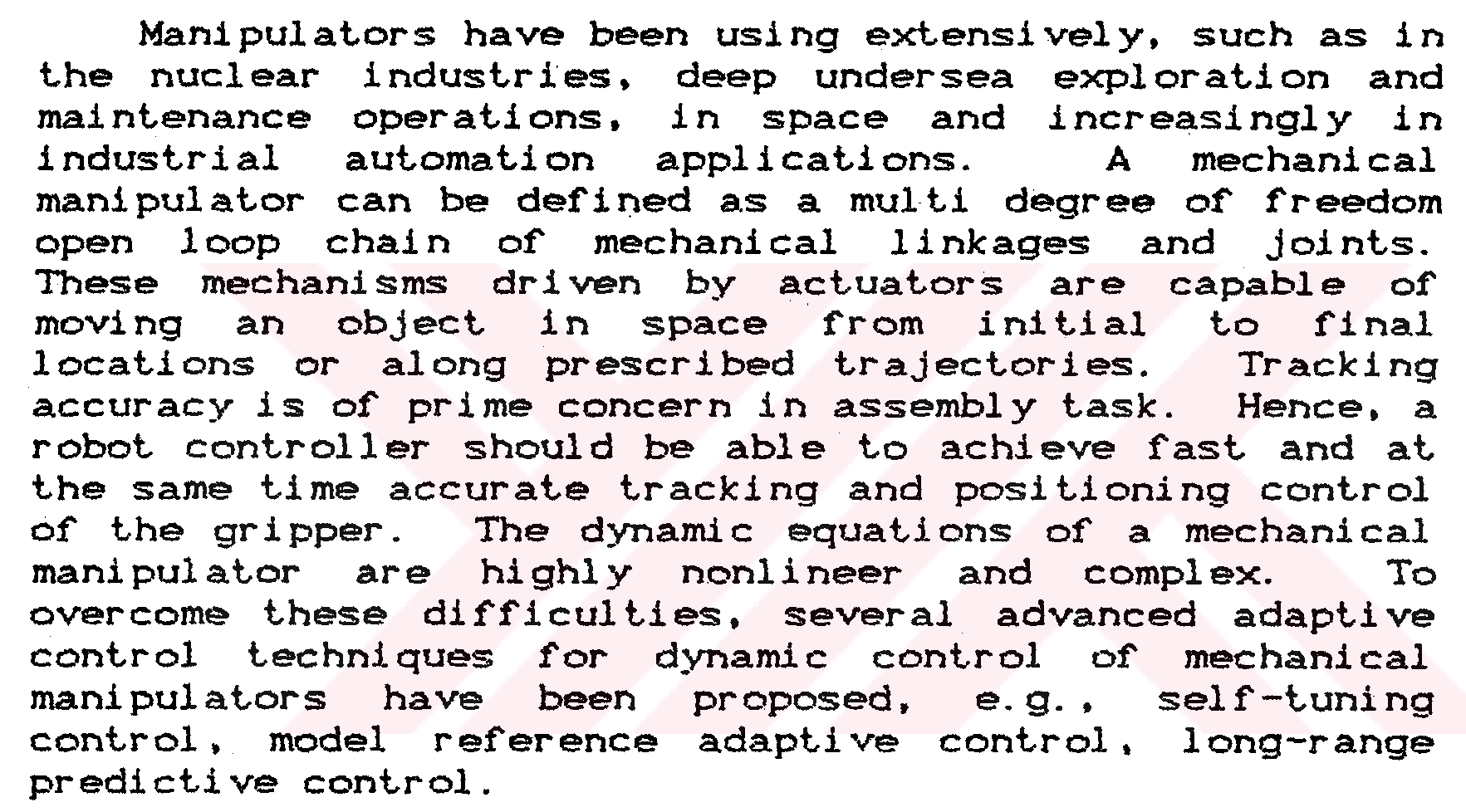
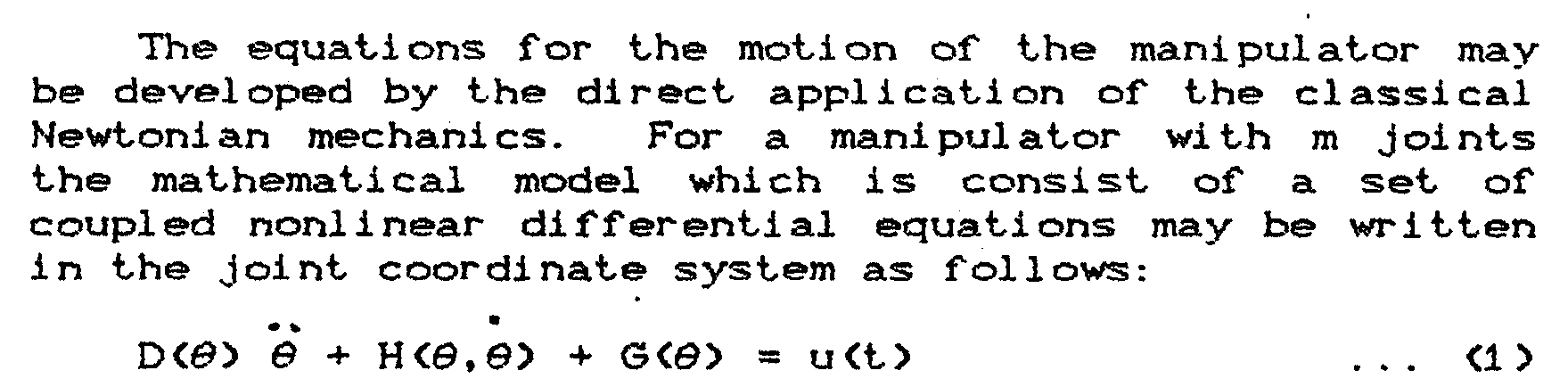
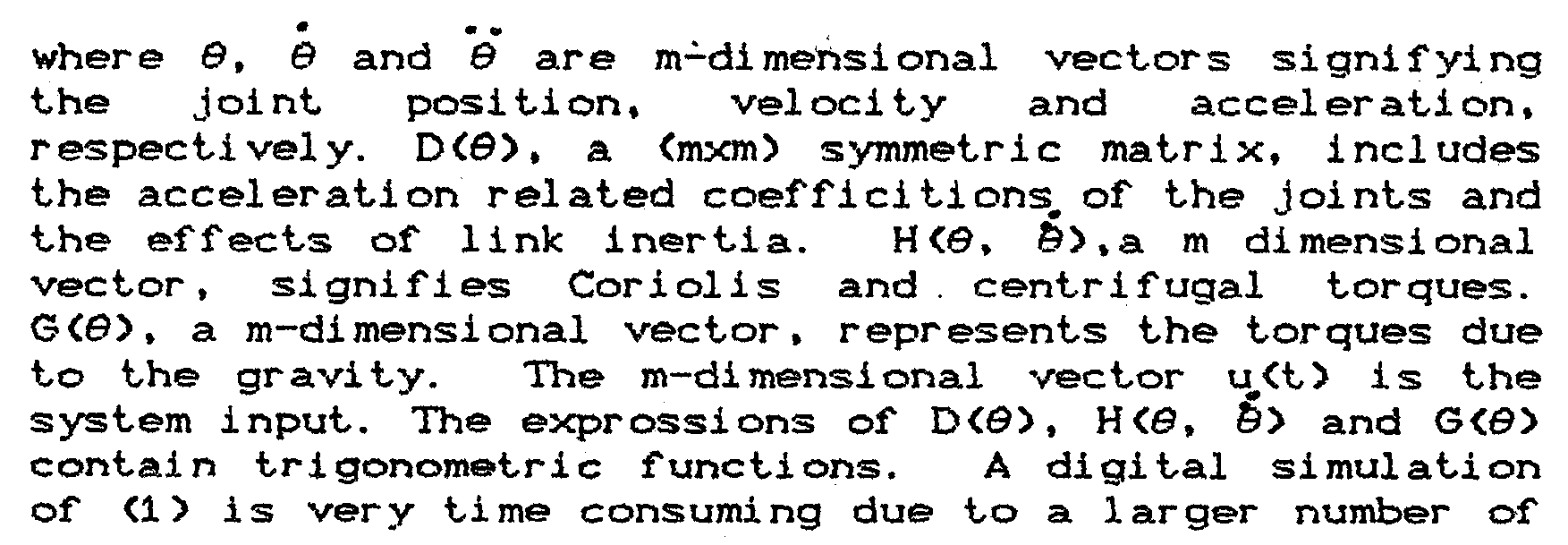
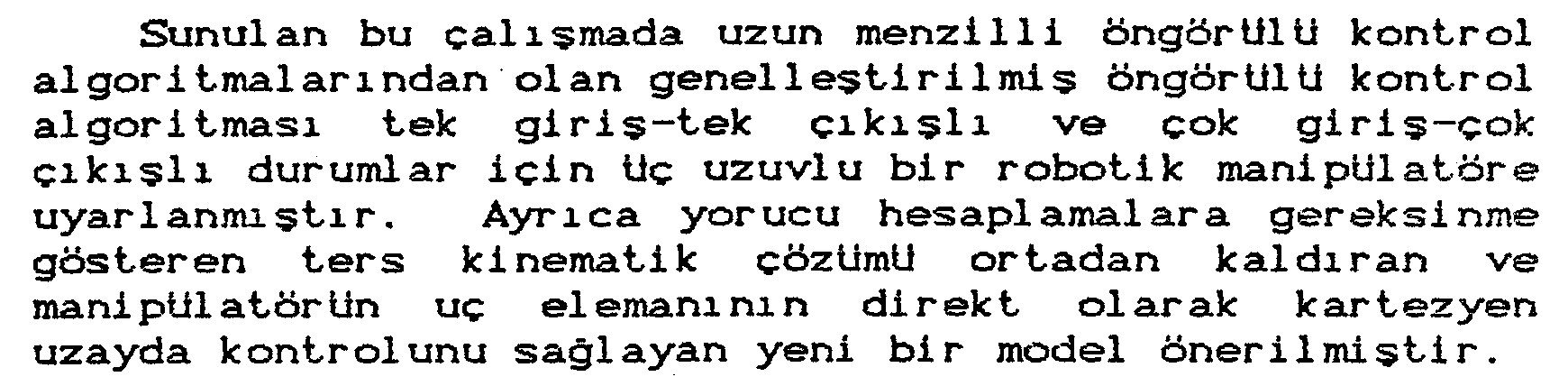
SUMMARY JOINT AND CARTESIAN BASED PREDICTIVE CONTROL OF A ROBOTIC MANIPULATOR In this study, SI SO and MIMO predictive control (Generalized predictive control -GPC) algorithms are proposed for the trajectory control of a three-link manipulator. Manipulator is controlled both in the joint coordinate system and directly in the cartesian coordinate system. Manipulators have been using extensively, such as in the nuclear industries, deep undersea exploration and maintenance operations, in space and increasingly in industrial automation applications. A mechanical manipulator can be defined as a multi degree of freedom open loop chain of mechanical linkages and joints. These mechanisms driven by actuators are capable of moving an object in space from initial to final locations or along prescribed trajectories. Tracking accuracy is of prime concern in assembly task. Hence, a robot controller should be able to achieve fast and at the same time accurate tracking and positioning control of the gripper. The dynamic equations of a mechanical manipulator are highly nonlineer and complex. To overcome these difficulties, several advanced adaptive control techniques for dynamic control of mechanical manipulators have been proposed, e.g., self-tuning control, model reference adaptive control, long-range predictive control. The equations for the motion of the manipulator may be developed by the direct application of the classical Newtonian mechanics. For a manipulator with m joints the mathematical model which is consist of a set of coupled nonlinear differential equations may be written in the joint coordinate system as follows: DW> 6 + H<©,©> + G<©> - uCt>... <1 > where 0, 0 and 0 are m-di mensi onal vectors signifying the joint position, velocity and acceleration, respectively. D<0>, a symmetric matrix, includes the acceleration related coef f i ci ti ons. of the joints and the effects of link inertia. HC©, ©>,a m dimensional vector, signifies Coriolis and. centrifugal torques. G<©>, a m-di mensi onal vector, represents the torques due to the gravity. The m-di mensi onal vector u, is the system input. The exprossions of D<0>, H<©, ©> and G<0> contain trigonometric functions. A digital simulation of <1> is very time consuming due to a larger number ofmathematical operations. More over, the parameter values vary from task to task. If the model in <1 > is first properly linearized about a nominal trajectory and then discretized by Euler's method» a mult i variable discrete-time model is obtained in the form. y = a + A y + A y + Bu + B u + e... <2> 2 where A. and B., i =1,2 are matrices, ao is the m-di mensi onal vector, and the vector e<. > represents modelling errors. The direct use of <2> is difficult because the calculation of the model parameters in the cofficient matrices is a tedious task. Modivated by the form of <2>, a CARIMA «Controlled Auto-Regressive Integrate Moving Average) model is proposed here to model the motion of a manipulator and to design a controller for the system. Such a model will be determined on the basis of the measured input -output data of a manipulator system. The parameters of the model will be determined so that the best fit of the model to the input -output data will be obtained in the least-squares error sense. As is well known, the parameters in such an assumed model can be estimated on-line using recursive equations. They can be obtained by minimizing the sum of the squared errors. The CARIMA model is assumed to have the same number of inputs and outputs. The CARIMA model will be written in the following general form: y = A y + B(q"1)u... <3> where the m-di mensi onal output vector y and the input vector u have as the ith component the output y. and the input u. of joint i, respectively, and 1=1,2,...,m. The equation error vector e in the CARIMA model is considered to be of the form: e = Ç/A... <4> where A is the differencing operator l-q~ and Ç is an uncorrelated random sequence. The argument q~ is backward shift operator. The matrices A and B are polynomials defined by: A a B = B +B q" *+...+ B q~nb... <6> O %? T% O Long-range predi eti ve control has recei vedmuch interest over the last few years as an alternative to one-step-ahead and pole-placement design methods in parameter adaptive control. The well-known Generalized Predictive Control has been found to posses features essential for successful application of self -tuning control to real processes, e.g., robustness against violation of modelling assumptions , applicability to a wide class of systems including open-loop unstable and/or nonminimum phase, and possibly time-varying processes. The majority of Generalized Predictive Control algorithm is basically a combination of a predictor, a cost function, an algorithm to choose a control sequence which minimizes this cost and a parametric identification scheme. The controller minimizes the quadratic cost function N N J = E Cy - yr3 + £ XAu' J=N. j = i <7> where y is the j -step-ahead prediction of the plant. The quantities N4, N^ and X are called the initial horizon, prediction horizon and the control weighting respectively. If we subject the minimization to the assumption that Au = O, for j > Nu, the control horizon, we arrive at the following solution: Au = -1 GT r <8> where: Au = EAu,Au....,Au3 u ty , y , r r,y 3 r 2 f = [f. f.,f] 2 G = g. o g. o o s N 9 2-i N -N 2 u and g. is the Jth value of the model step response. The term J f Ct+J> is the free response of the plant at time t+j, i.e. the output of the model at this time assuming zero future control increments. y is the set point at time t. XIIThe generalized predictive control algorithm will become: 1>- Measure the plant output and external set -point, 2>- Estimate the parameters of the plant using RLS, 3>- Compute the free response f , 4>- Compute g. parameters and Au using Eqn. <8>, S>- Shift the data ready for the next sample. In order to evaluate the behaviour of the generalized predictive control strategies, four sets of simulation studies were carried out (Chapter 5 >. For each set the purpose of the simulation study, the description of the simulated system, the criterion for selecting the tuning parameters, the set point changes and disturbances are described. From the simulation studies it can be concluded that the generalized predictive control algorithms offer interesting features making them suitable for real -lif e- appl i cati ons. This study presents SI SO and MI MO generalized predictive control algorithms CGPO for the trajectory control of a three link manipulator. The performance of the predictive controller was tested for several reference trajectories and under stochastic and deter mi niştik disturbances. Seperate Joint Control : The problem is to design a predictive controller for each joint so as to make the angular motion of each joint follow a desired path specified by discrete points. It is assumed that interactions between the joints are small. Thus coupling terms in the CARIMA model of the manipulator system are omitted and each joint will be controlled independently of the other. For the system, the input is the torque u; applied to the joint motor, and the output is the velocity V. of the joint. Simulations indicate that the system performs well when the seperate joint control is applied. The main advantage of a seperate Joint control is that it is simple. Moreover, the controller can be implemented using microprocessors since the number of updating system parameters is less. Predictive Controller for Interacting Joi nts CMI MO> : In this control scheme, the dynamic couplings are taken into consideration in the design of multivariable GPC controller. The task here is to determine a predictive control scheme for the manipulator joints such that the motion of the manipulator Joints follow a desired path as closely as possible for this system, the input is the torque u. applied to the Joint motor and the output is a XIIImathematical operations. More over, the parameter values vary from task to task. If the model in <1 > is first properly linearized about a nominal trajectory and then discretized by Euler's method» a mult i variable discrete-time model is obtained in the form. y = a + A y + A y + Bu + B u + e... <2> 2 where A. and B., i =1,2 are matrices, ao is the m-di mensi onal vector, and the vector e<. > represents modelling errors. The direct use of <2> is difficult because the calculation of the model parameters in the cofficient matrices is a tedious task. Modivated by the form of <2>, a CARIMA «Controlled Auto-Regressive Integrate Moving Average) model is proposed here to model the motion of a manipulator and to design a controller for the system. Such a model will be determined on the basis of the measured input -output data of a manipulator system. The parameters of the model will be determined so that the best fit of the model to the input -output data will be obtained in the least-squares error sense. As is well known, the parameters in such an assumed model can be estimated on-line using recursive equations. They can be obtained by minimizing the sum of the squared errors. The CARIMA model is assumed to have the same number of inputs and outputs. The CARIMA model will be written in the following general form: y = A y + B(q"1)u... <3> where the m-di mensi onal output vector y and the input vector u have as the ith component the output y. and the input u. of joint i, respectively, and 1=1,2,...,m. The equation error vector e in the CARIMA model is considered to be of the form: e = Ç/A... <4> where A is the differencing operator l-q~ and Ç is an uncorrelated random sequence. The argument q~ is backward shift operator. The matrices A and B are polynomials defined by: A a B = B +B q" *+...+ B q~nb... <6> O %? T% O Long-range predi eti ve control has recei vedThe generalized predictive control algorithm will become: 1>- Measure the plant output and external set -point, 2>- Estimate the parameters of the plant using RLS, 3>- Compute the free response f , 4>- Compute g. parameters and Au using Eqn. <8>, S>- Shift the data ready for the next sample. In order to evaluate the behaviour of the generalized predictive control strategies, four sets of simulation studies were carried out (Chapter 5 >. For each set the purpose of the simulation study, the description of the simulated system, the criterion for selecting the tuning parameters, the set point changes and disturbances are described. From the simulation studies it can be concluded that the generalized predictive control algorithms offer interesting features making them suitable for real -lif e- appl i cati ons. This study presents SI SO and MI MO generalized predictive control algorithms CGPO for the trajectory control of a three link manipulator. The performance of the predictive controller was tested for several reference trajectories and under stochastic and deter mi niştik disturbances. Seperate Joint Control : The problem is to design a predictive controller for each joint so as to make the angular motion of each joint follow a desired path specified by discrete points. It is assumed that interactions between the joints are small. Thus coupling terms in the CARIMA model of the manipulator system are omitted and each joint will be controlled independently of the other. For the system, the input is the torque u; applied to the joint motor, and the output is the velocity V. of the joint. Simulations indicate that the system performs well when the seperate joint control is applied. The main advantage of a seperate Joint control is that it is simple. Moreover, the controller can be implemented using microprocessors since the number of updating system parameters is less. Predictive Controller for Interacting Joi nts CMI MO> : In this control scheme, the dynamic couplings are taken into consideration in the design of multivariable GPC controller. The task here is to determine a predictive control scheme for the manipulator joints such that the motion of the manipulator Joints follow a desired path as closely as possible for this system, the input is the torque u. applied to the Joint motor and the output is a XIII
Author
Dr. Recep Kazan

How to Cite
Recep Kazan (Doctorate thesis). Joint and cartesian based predictive control of a robotic manipulator, 1992, Istanbul Technical University.
Figures & Images (302)

License
Tüm Hakları Saklıdır
This work is shared under the specified license terms.
More theses from Istanbul Technical University
- Investigation Of Stretching Effect With Mixed Finite Element Formulations For Laminated Beams And Plates(2023)
- Classification of anemia using data mining methods: An application(2015)
- Removal and recovery of platinum group metals through anode slimes of moebius electrolysis(2015)
- A study of design approaches to Istanbul's city halls based on space syntax theory(2015)
- A II. German Empire project: From Kaiser Wilhelm Monument to German fountain(2015)
- Uzaktan algılama verilerinin yersel ölçümlerle entegrasyonu ile toprak tuzluluk haritalaması; Aşağı Seyhan Ovası, Adana, Türkiye(2015)