
 indexed
Development and implementation of an artificial intelligence-based decision support system for fault detection and diagnosis in photovoltaic systems
2026
15 pages
4 views
0 downloads
Advisor: Prof.Dr.Naim Süleyman TINĞ
Abstract (EN)
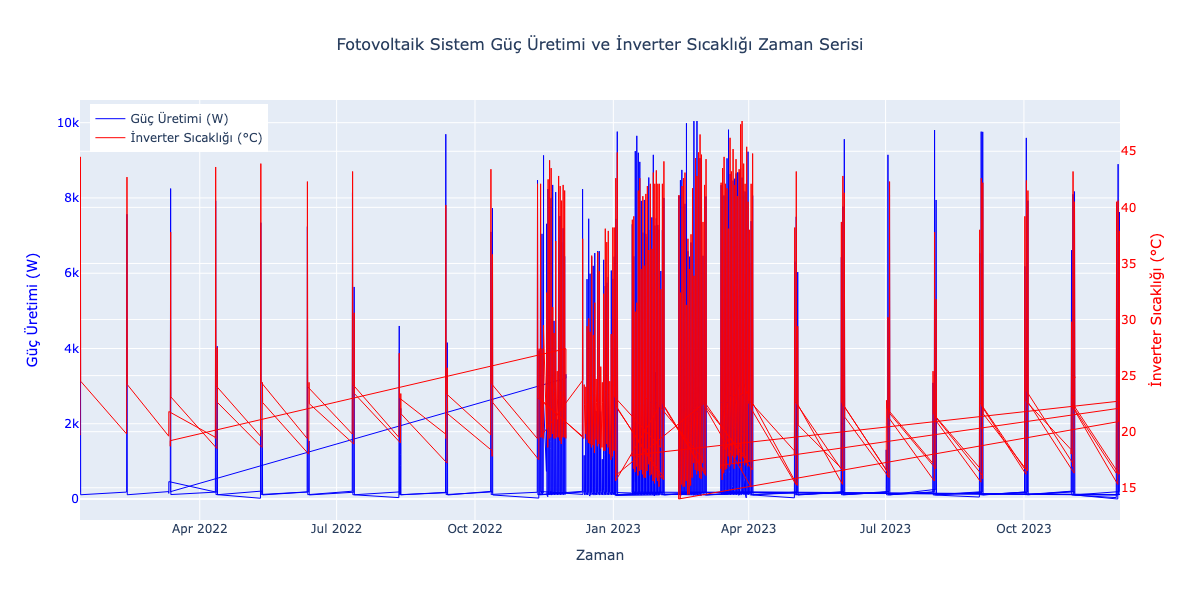
The efficient and safe operation of Solar Power Plants (SPP) depends on the autonomous detection of photovoltaic (PV) faults. In this thesis, an original multimodal Decision Support System (DSS) based on electrical analytics and computer vision was designed by processing multidimensional chronological sensor data obtained from a 10 kWp domestic PV system installed in the Van/Başkale region under varying seasonal conditions and operational scenarios.
In the first stage, the fault detection performances of Machine Learning (ML) and Deep Learning (DL) architectures were compared on sensor data. A lightweight ML layer was constructed through statistical residual analysis, utilizing the Isolation Forest algorithm for unsupervised pre-filtering and the HistGradientBoosting (HGB) model for supervised power estimation. This infrastructure was benchmarked against a 1D-CNN-LSTM Hybrid Autoencoder architecture, which hierarchically learns temporal and spatial features, based on accuracy, F1-Score, and computational cost criteria. To clarify the "black box" nature of the deep learning model, an Explainable AI (XAI) layer was established by integrating the SHAP algorithm into the system.
In the second stage, to autonomously verify the physical causes of electrical anomalies (such as micro-cracks, fractures, soiling, and shading), panel images collected from the field were labeled on Roboflow and trained using the Transformer-based RF-DETR object detection architecture. Physical deformations were successfully mapped with a confidence score exceeding 95%.
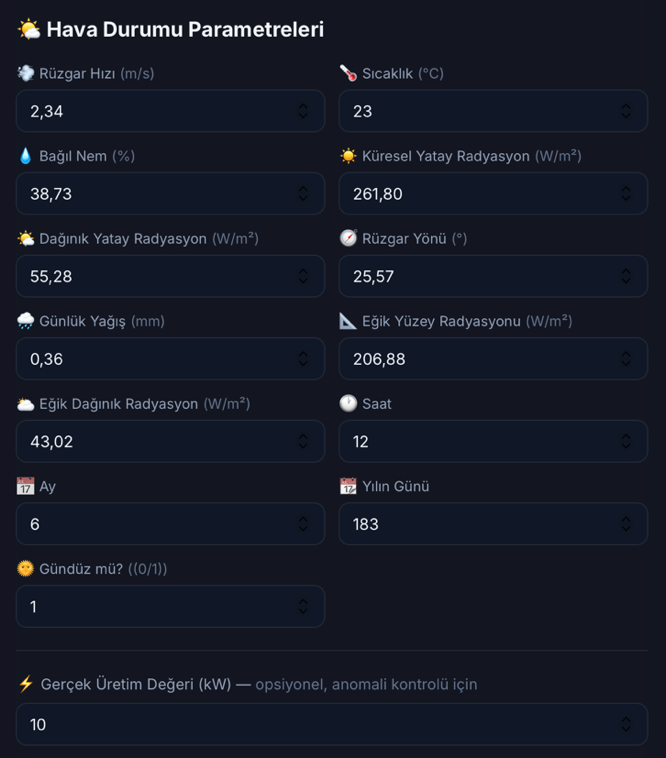
In the final stage, all analytical and visual models were integrated into a unified user interface using the Antigravity infrastructure. The developed DSS fuses two different data sources to provide the operator with instantaneous "Predicted Percentage of Efficiency Loss (%)" and action-oriented "Maintenance Recommendations." Empirical findings demonstrate that the proposed DSS infrastructure significantly enhances predictive maintenance reliability in domestic SPP projects while substantially reducing operational downtime and technical maintenance costs.
Institution

How to Cite
Muhammed Bugrahan Kaya (Master Thesis). Development and implementation of an artificial intelligence-based decision support system for fault detection and diagnosis in photovoltaic systems, 2026, pp. 1-15, Erzincan Binali Yıldırım University, Elektrik ve Elektronik Mühendisliği Bölümü, DOI: https://doi.org/10.71008/ebyu.thesis.2026.193.
Figures & Images (14)
Keywords
DOI Status
Requested
Under Review
Approved
DOI Assigned
DOI & Cite
License
Tüm Hakları Saklıdır
This work is shared under the specified license terms.
More theses from Erzincan Binali Yıldırım University
- From a Schmıttian perspective, ideological divisions and the state's efforts to homogenize society in 20th century Türkiye (2026)
- YAPAY ZEKA VE PROGRAMLAMA: ÖĞRETMENLERİN PROGRAMLAMA ÖZ YETERLİLİKLERİ, YAPAY ZEKA FARKINDALIKLARI VE EĞİTİMDE YAPAY ZEKA KULLANIMINA İLİŞKİN GÖRÜŞLERİNİN İNCELENMESİ(2026)
- Eksik(2022)
- Synthesis of ordered double transition metal Ti2NbAlC2 MAX phase and investigation of energy storage properties of Ti2NbC2Tx MXene(2026)
- Investigation of structural behavior of corroded RC columns(2020)
- Profiles of marriage anxiety of young adults(2026)