
Restoration of images degraded by additive gaussion noise by means of kalman filtering
1994
0 views
0 downloads
Advisor: Y.doç.dr. M. Ertuğrul Çelebi
Abstract (EN)
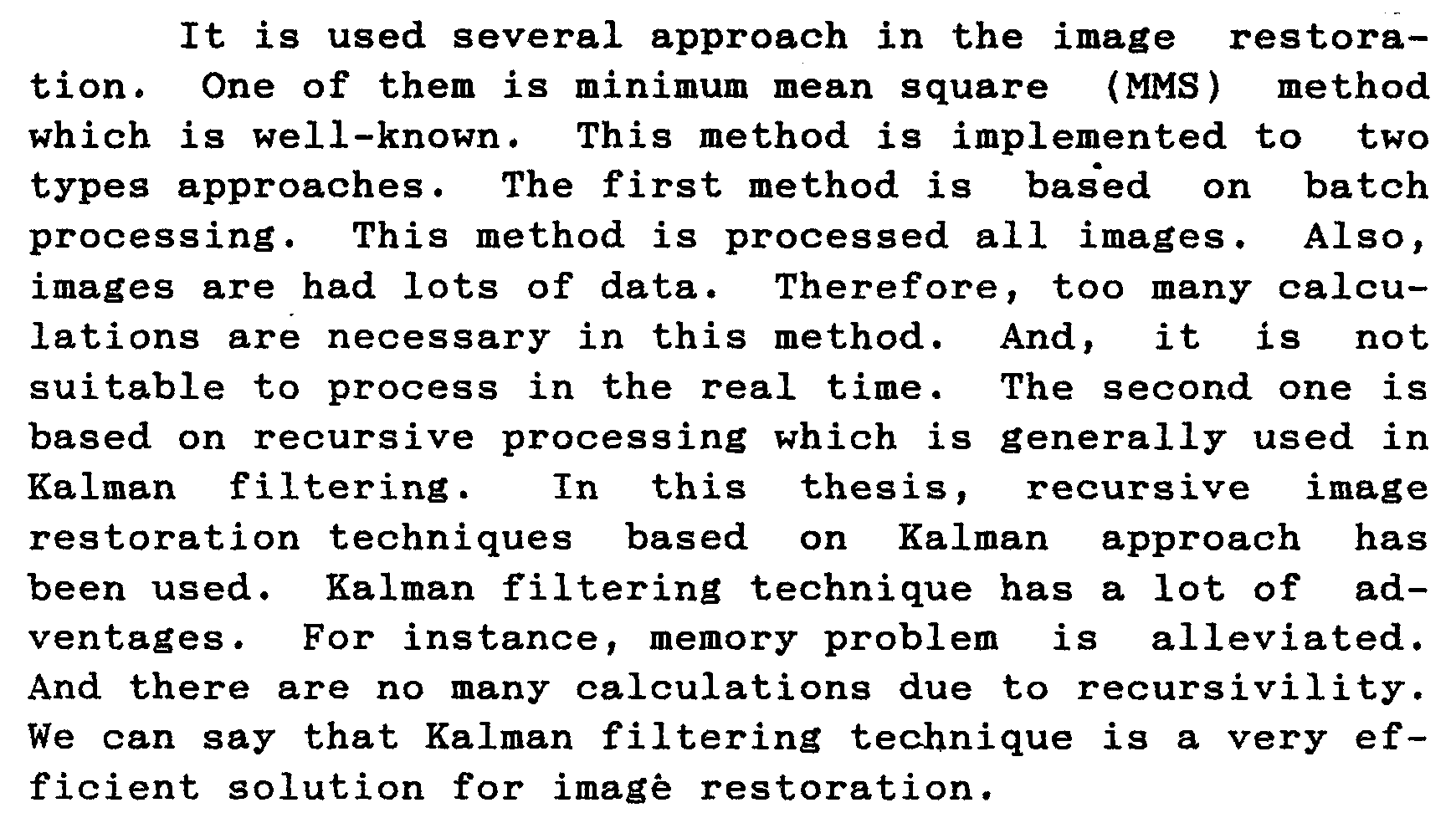
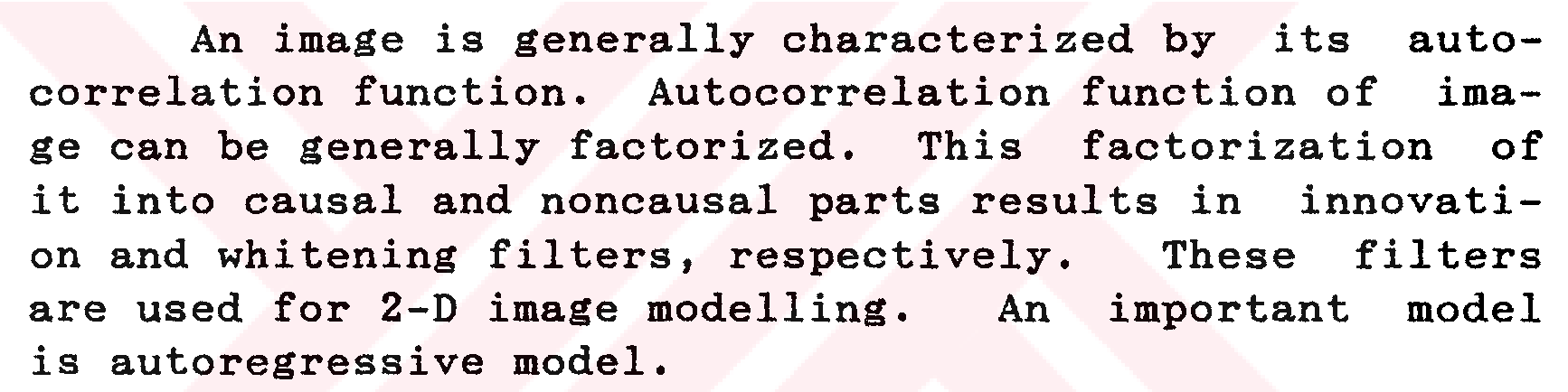
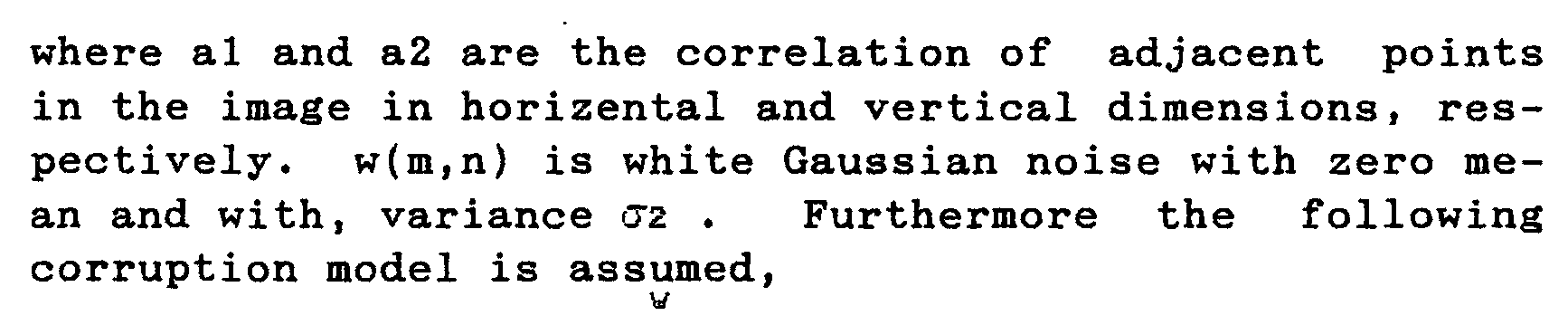
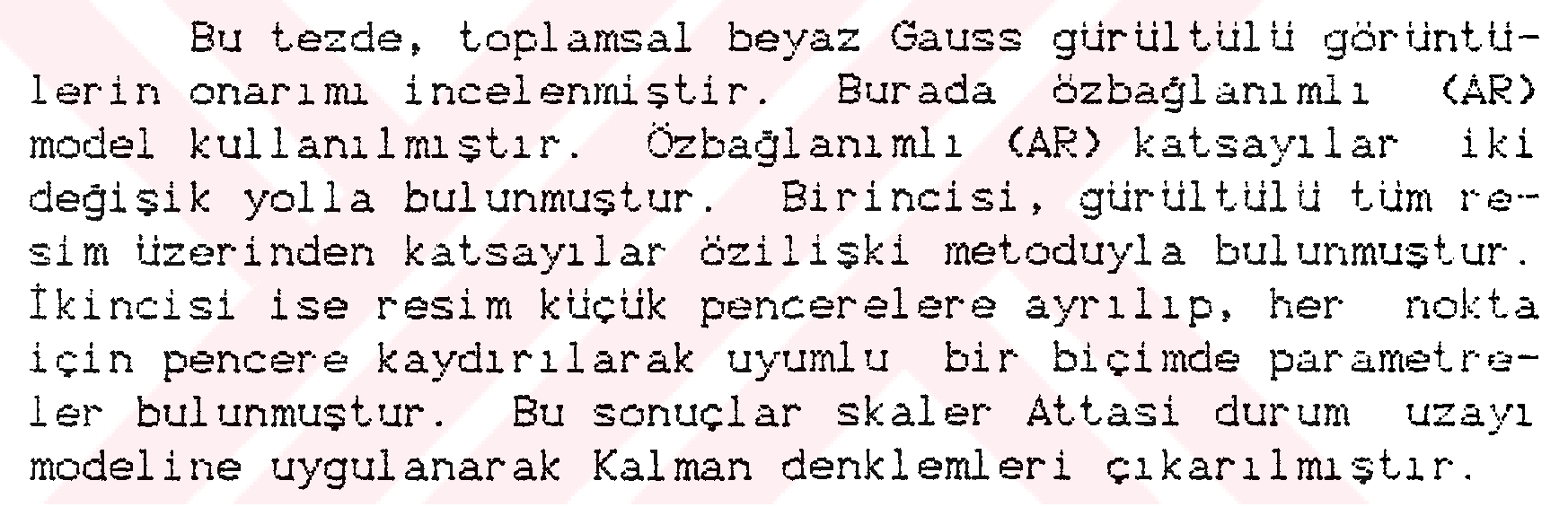
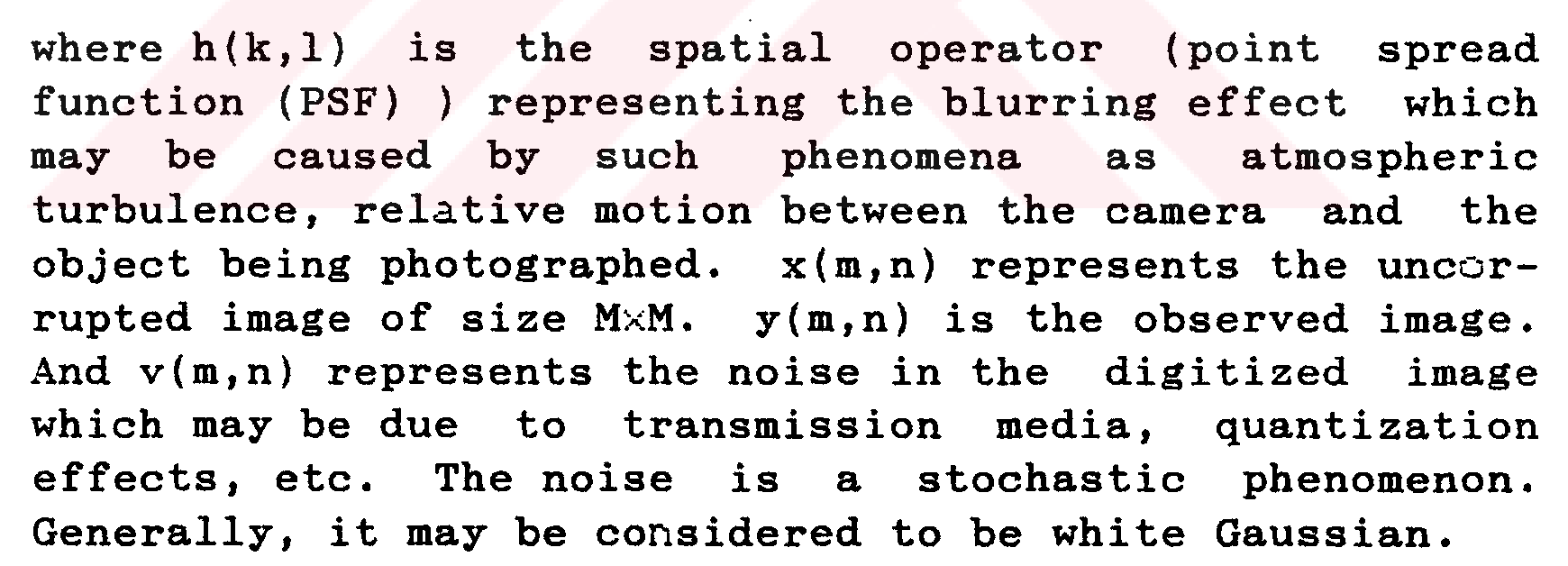
A fundamental problem in images analysis is res toration. Images consist of lots of gray levels. The model of the image formation system for blur red and noisy image is y(m,n)=£ h(k, l)x(m-k,n-l)+v(m,n) (1) kl where h(k,l) is the spatial operator (point spread function (PSF) ) representing the blurring effect which may be caused by such phenomena as atmospheric turbulence, relative motion between the camera and the object being photographed. x(m,n) represents the uncor- rupted image of size MxM. y(m,n) is the observed image. And v(m,n) represents the noise in the digitized image which may be due to transmission media, quantization effects, etc. The noise is a stochastic phenomenon. Generally, it may be considered to be white Gaussian. (1 ) can be written in the vector form as follow, y=Hx+v where y is observation vector, H is blurring matrix, x is original image vector and v is addittive white noise. In this thesis, it is assumed no blurring effects. The main aim of the image restoration is to esti mate x(m,n) from the observed image y(m,n) given the PSF (ix)and some statistical information of the noise. It is used several approach in the image restora tion. One of them is minimum mean square (MMS) method which is well-known. This method is implemented to two types approaches. The first method is based on batch processing. This method is processed all images. Also, images are had lots of data. Therefore, too many calcu lations are necessary in this method. And, it is not suitable to process in the real time. The second one is based on recursive processing which is generally used in Kalman filtering. In this thesis, recursive image restoration techniques based on Kalman approach has been used. Kalman filtering technique has a lot of ad- ventages. For instance, memory problem is alleviated. And there are no many calculations due to recursivility. We can say that Kalman filtering technique is a very ef ficient solution for image restoration. An image is generally characterized by its auto correlation function. Autocorrelation function of ima ge can be generally factorized. This factorization of it into causal and noncausal parts results in innovati on and whitening filters, respectively. These filters are used for 2-D image modelling. An important model is autoregressive model. Autoregressive (AB) model paremeters are found from autocorrelation function. First order AR scalar image model corresponding to separable and exponential autocorrelation function is as follow, x(m,n) =alx(m-l.n)+a2x(m,n-l )-ala2x(m-l, n-1 ) +w(m,n) (3) where al and a2 are the correlation of adjacent points in the image in horizental and vertical dimensions, res pectively. w(m,n) is white Gaussian noise with zero me an and with, variance where, y (m,n)={y(m-L,n-L),..,y(m-L,n+L),....,y(m,n-l) ^?- 1 £L t & i 9-..... 9. -L-L -LL -L+l-L O-L,..., a j 0-1 and N is the number of observation in the window W. D is the LxL model support region. This method is given very efficient solution for estimation of AR parameters. In this method, W window is an important size. The size of W must be small eno ugh for the homogeneity assumption to hold and yet large enough to be able to sufficiently reduce the effects of any noise. Both methods are incorporated into Kalman filte ring equations. Kalman filtering equations are found in (xii)vector form and scalar form. Based on the state space representation of the model Kalman filter for the observation state is designed which yields the best es timates for the both methods. The equations of the Kalman filter are given as follows,. First, the state and observation equations are, x(m,n)=a x(m-l,n)+a x(m,n-l)-a a x(m-l,n-l) (17) 1 2 12 y(m,n)=x(m,n)+v(m,n) (18) Prediction (time update) equations, x(m,n)=a x(m-l,n)+a x(m,n-l)-a a x(m-l,n-l) (19) i 2 12 2,2 2 2 M(m,n)=a P(m-l,n)+ a P(m,n-l)-a a P(m-1,n-l ) +q( 20) 1 2 12 where q is driving noise variance. Filtering (measurement update) equation, K(m,n)=M(m,n)[M(m,n)+r] * (21) x(m,n)=x(m,n)+K(m,n)[y(m,n)-x(m,n)] (22) P(m,n)=M(m,n) r [M(m,n)+r J-i (23) where r is observation noise variance. All those equation are applied to LENA image step-by-step and the results are compared each other. For making comparision, input SNR and output SNR are used. And defining the filter gain (G), improvement is observed between input and output. As a result, we can say that the second method is very efficient than the other. The second method updates the parameters and the filter predicts the (xiii)original data from noisy image. If the input SNR is too low then the filter per formance is to be bad. Therefore, in the low SNR, this method must be improved which may be second order model ling, or another parameter estimation. But*, high order modelling is required too many calculations. (xiv)
Author
Dr. Yaşar Becerikli

How to Cite
Yaşar Becerikli (Master Thesis). Restoration of images degraded by additive gaussion noise by means of kalman filtering, 1994, Istanbul Technical University.
Figures & Images (97)

Keywords
License
Tüm Hakları Saklıdır
This work is shared under the specified license terms.
More theses from Istanbul Technical University
- Investigation Of Stretching Effect With Mixed Finite Element Formulations For Laminated Beams And Plates(2023)
- Classification of anemia using data mining methods: An application(2015)
- Removal and recovery of platinum group metals through anode slimes of moebius electrolysis(2015)
- A study of design approaches to Istanbul's city halls based on space syntax theory(2015)
- A II. German Empire project: From Kaiser Wilhelm Monument to German fountain(2015)
- Uzaktan algılama verilerinin yersel ölçümlerle entegrasyonu ile toprak tuzluluk haritalaması; Aşağı Seyhan Ovası, Adana, Türkiye(2015)