
 indexed
Interactive children's rights education using artificial intelligence: An example from the 4th-grade human rights, civics, and democracy course
2026
1 pages
2 views
0 downloads
Advisor: Doç. Dr. Z. Fatih İNEÇ
Abstract (EN)
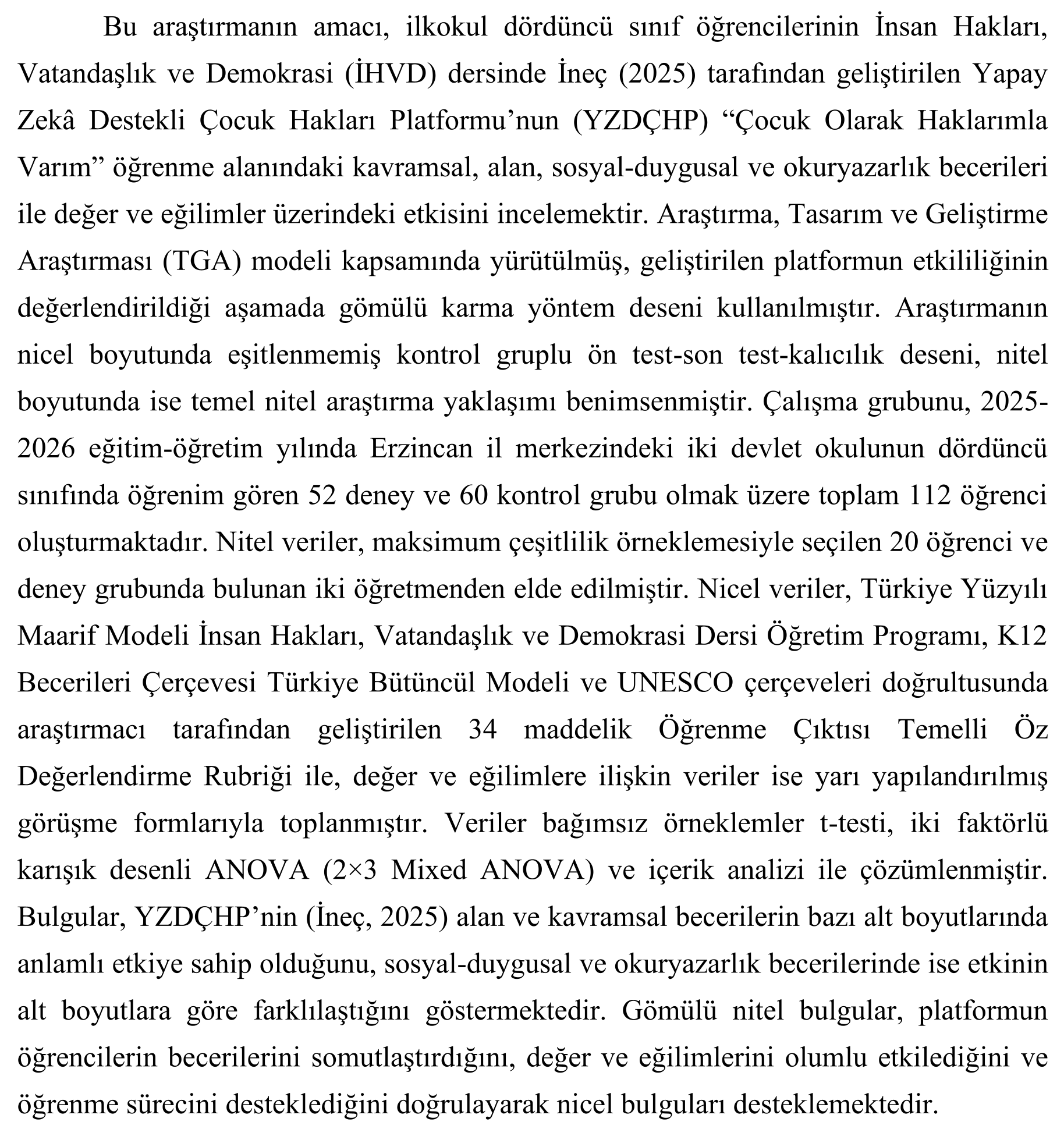
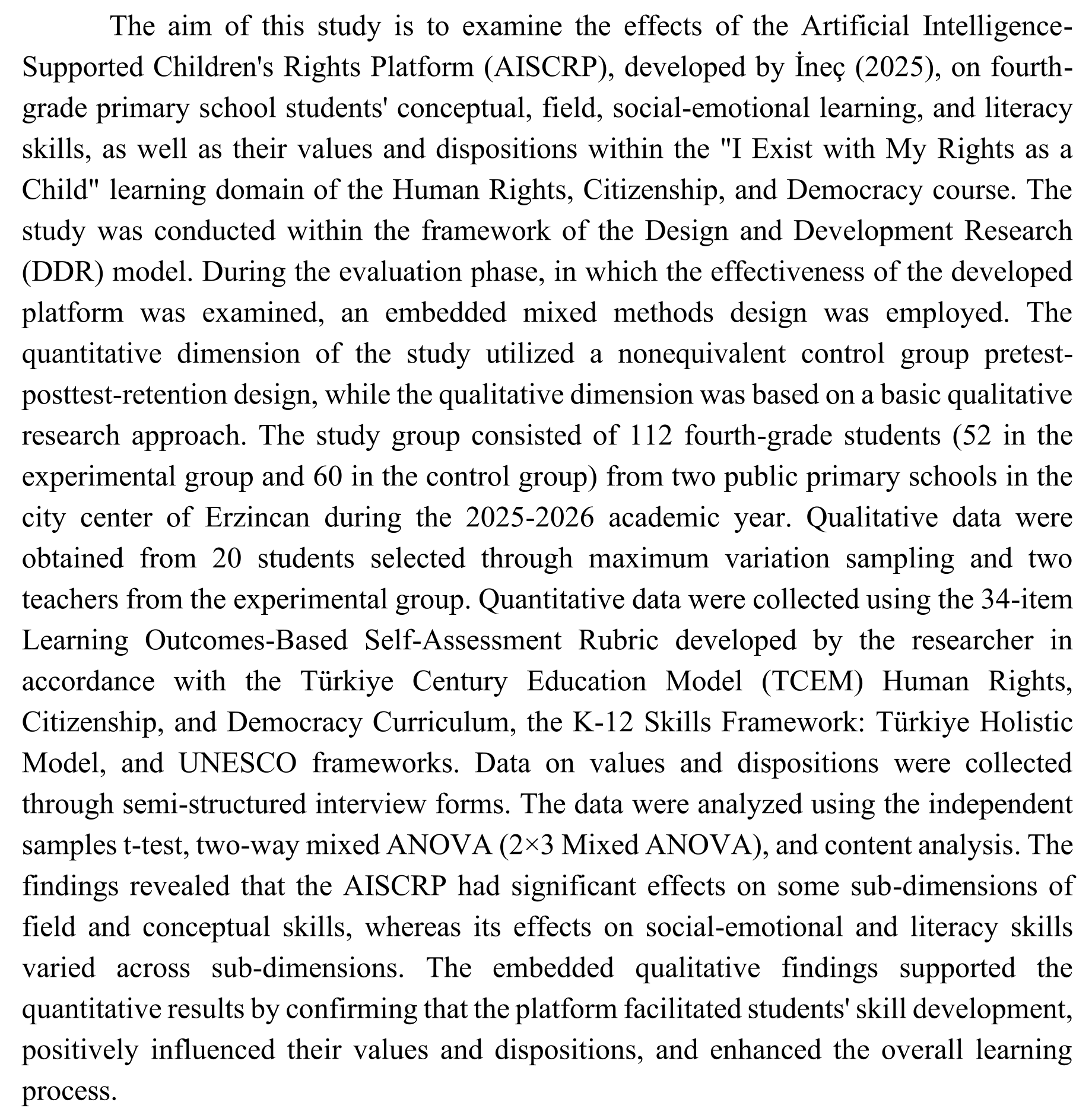
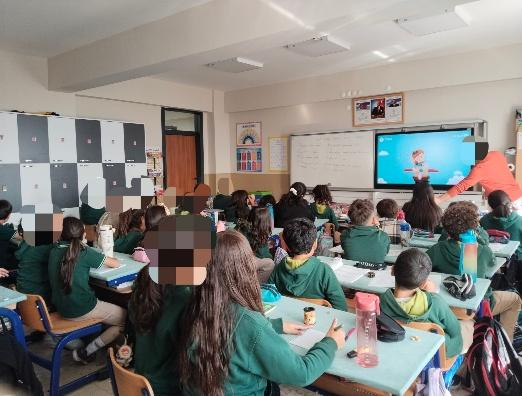
The aim of this study is to examine the effects of the Artificial Intelligence Supported Children's Rights Platform (AISCRP), developed by İneç (2025), on fourth grade primary school students' conceptual, field, social-emotional learning, and literacy skills, as well as their values and dispositions within the "I Exist with My Rights as a Child" learning domain of the Human Rights, Citizenship, and Democracy course. The study was conducted within the framework of the Design and Development Research (DDR) model. During the evaluation phase, in which the effectiveness of the developed platform was examined, an embedded mixed methods design was employed. The quantitative dimension of the study utilized a nonequivalent control group pretest posttest-retention design, while the qualitative dimension was based on a basic qualitative research approach. The study group consisted of 112 fourth-grade students (52 in the experimental group and 60 in the control group) from two public primary schools in the city center of Erzincan during the 2025-2026 academic year. Qualitative data were obtained from 20 students selected through maximum variation sampling and two teachers from the experimental group. Quantitative data were collected using the 34-item Learning Outcomes-Based Self-Assessment Rubric developed by the researcher in accordance with the Türkiye Century Education Model (TCEM) Human Rights, Citizenship, and Democracy Curriculum, the K-12 Skills Framework: Türkiye Holistic Model, and UNESCO frameworks. Data on values and dispositions were collected through semi structured interview forms. The data were analyzed using the independent samples t-test, two-way mixed ANOVA (2×3 Mixed ANOVA), and content analysis. The findings revealed that the AISCRP had significant effects on some sub-dimensions of field and conceptual skills, whereas its effects on social-emotional and literacy skills varied across sub-dimensions. The embedded qualitative findings supported the quantitative results by confirming that the platform facilitated students' skill development, positively influenced their values and dispositions, and enhanced the overall learning process.
Institution

Erzincan Binali Yıldırım University
Division of Social Studies Education
How to Cite
Sıla İnan (Master Thesis). Interactive children's rights education using artificial intelligence: An example from the 4th-grade human rights, civics, and democracy course, 2026, pp. 1-1, Erzincan Binali Yıldırım University, DOI: https://doi.org/10.71008/ebyu.thesis.2026.231.
Figures & Images (33)

DOI Status
Requested
Under Review
Approved
DOI Assigned
DOI & Cite
License
Tüm Hakları Saklıdır
This work is shared under the specified license terms.
More theses from Erzincan Binali Yıldırım University
- From a Schmıttian perspective, ideological divisions and the state's efforts to homogenize society in 20th century Türkiye (2026)
- YAPAY ZEKA VE PROGRAMLAMA: ÖĞRETMENLERİN PROGRAMLAMA ÖZ YETERLİLİKLERİ, YAPAY ZEKA FARKINDALIKLARI VE EĞİTİMDE YAPAY ZEKA KULLANIMINA İLİŞKİN GÖRÜŞLERİNİN İNCELENMESİ(2026)
- Investigation of structural behavior of corroded RC columns(2020)
- Eksik(2022)
- Synthesis of ordered double transition metal Ti2NbAlC2 MAX phase and investigation of energy storage properties of Ti2NbC2Tx MXene(2026)
- Profiles of marriage anxiety of young adults(2026)