
A Hybrid method for numerical solutions of inverse scattering problems related to cylindrical bodies buried in a half-space
1992
0 görüntülenme
0 i̇ndirme
Danışman: Prof. Dr. Mithat İdemen
Özet (EN)
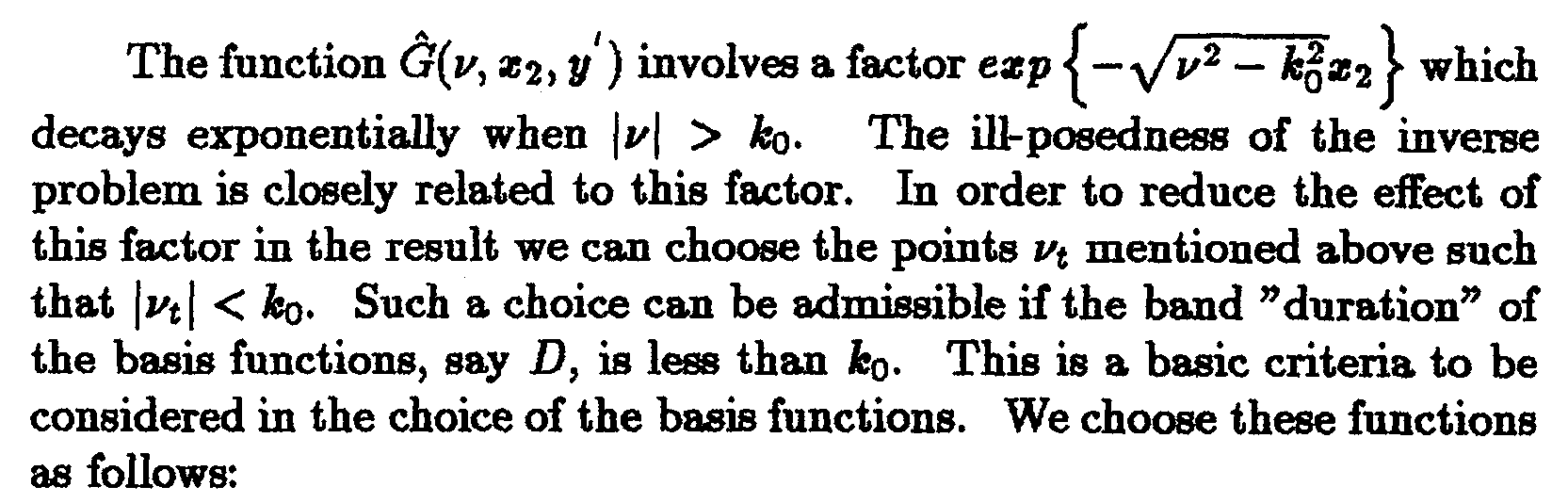
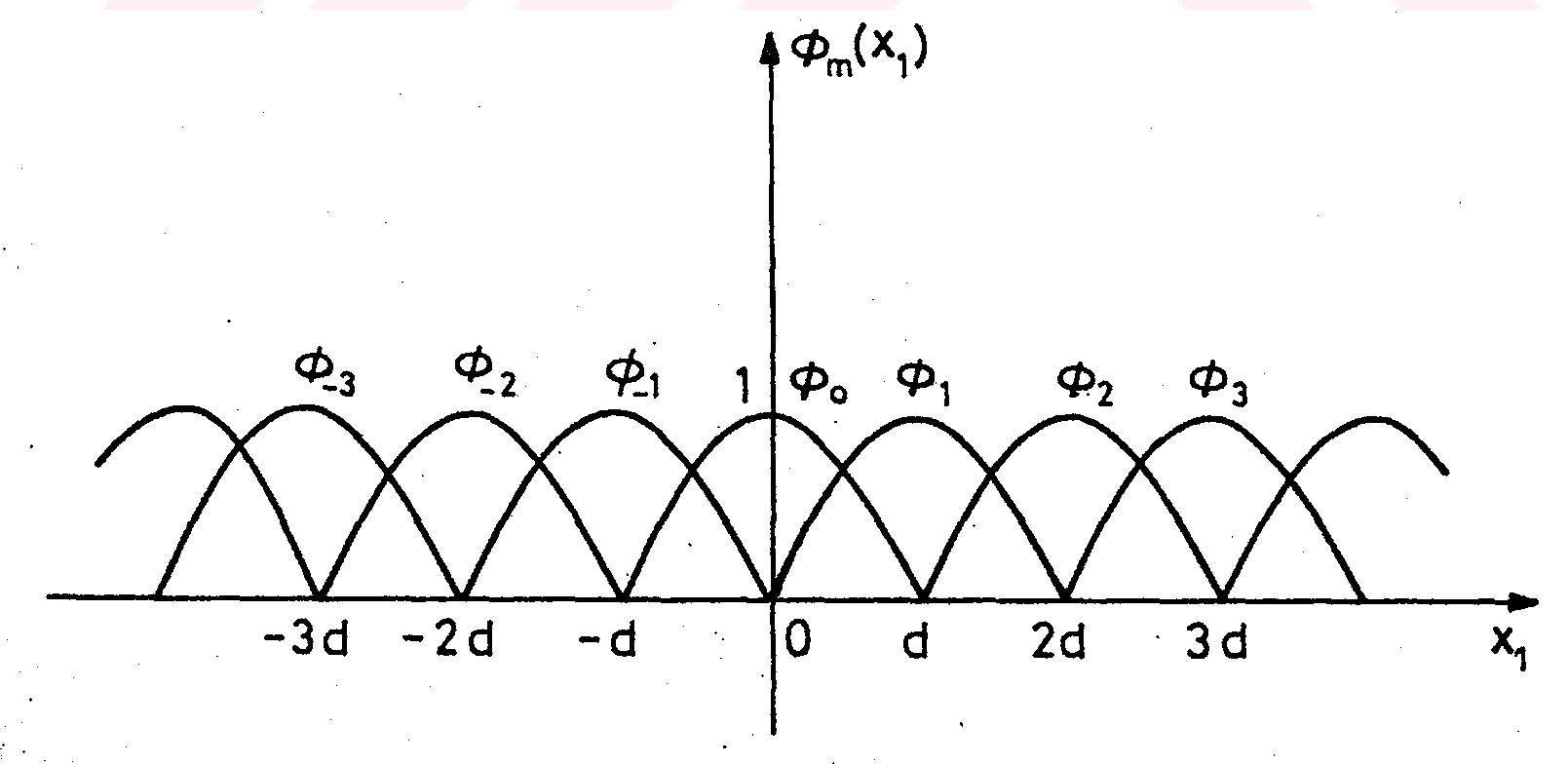
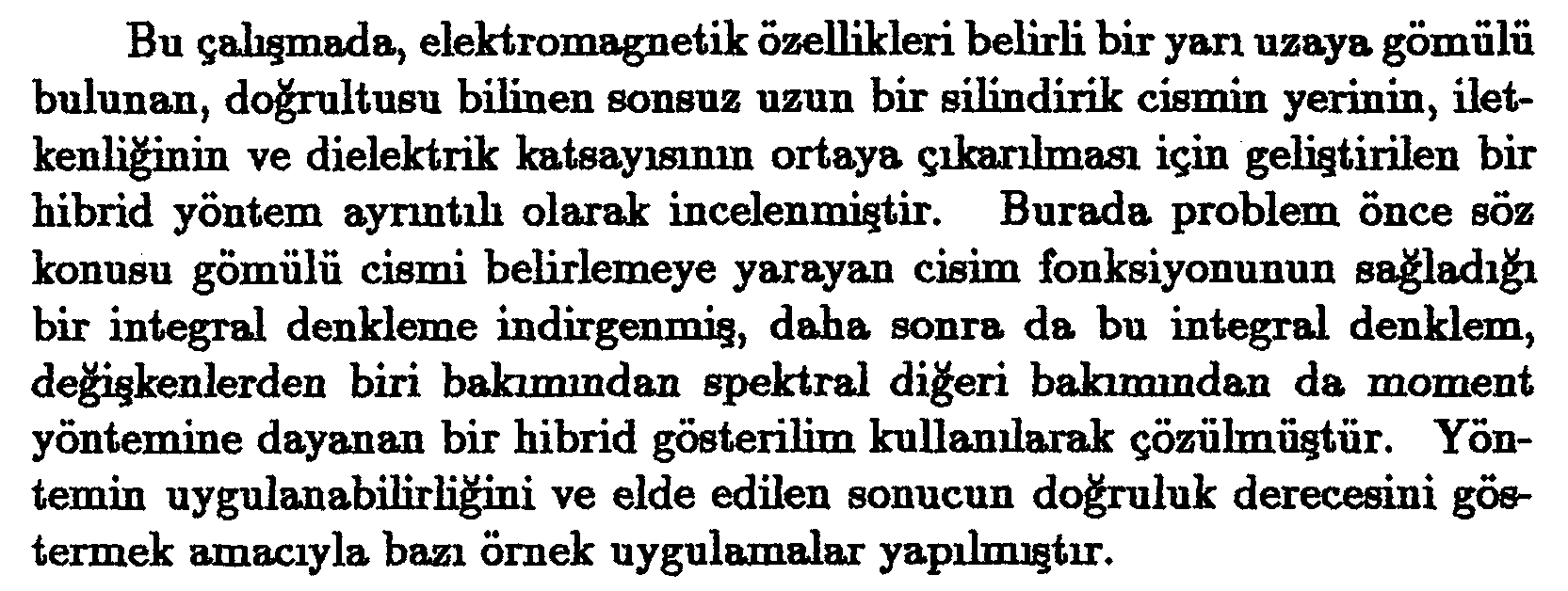
SUMMARY A HYBRID METHOD FOR NUMERICAL SOLUTIONS OP INVERSE SCATTERING PROBLEMS RELATED TO CYLINDRICAL BODIES BURIED IN A HALF-SPACE The main objective in an inverse scattering problem is to recover the geometrical (location and shape) and physical (constitutive parameters) properties of an inaccessible body by considering its effect on the propa gation of certain waves. During last two decades enormous efforts have been devoted to the investigation of these problems. Most of the available publications concern the bodies located in an infinite homogeneous space whereas the bodies buried in a known host medium is much more impor tant from both pur scientific and application points of view. The available investigations related to buried bodies are, in general, exact investigations dwelling on spectral representations of the field. These investigations are based on certain approximate equations (for example the well-known Born approximation) and, hence, concern only certain particular cases. In order to be able to treat more general cases one has to develop suitable numer ical techniques. But as far as we know, purely numerical investigations devoted to inverse scattering problems connected with "buried bodies" have not been published till now. One of the main difficulties in direct numerical techniques is that they are more susceptible to the ill-posedness, inherent to inverse problems, as compared to the exact methods dwelling on spectral representation. In the case of buried objects an other diffi culty is added to the ill-posedness; namely: an explicit expression of the related Green function, suitable to numerical computations, is not known. The aim of this work is to develop a "hybrid" method suitable to the case of cylindrical bodies buried in a half-space. This method which dwell on a spectral representation with respect to one of the space coordinates while the representation in the other coordinate is given through finite elements reduces also the effect of the ill-posedness on the result. The essential points of the method will be explained below. We remark that our concern is only the electromagnetic properties of the body. VILet the half-spaces X2 > 0 and x% < 0 be filled with the simple non conducting and non-magnetic materials having different permittivities eo and £1, respectively. We assume that the region x% < 0 involves a non magnetic cylindrical body V whose permittivity c(z ) and conductivity 0 such that the electric field is parallel to the aj3-axis, i.e.: J5* = (0, 0, ul(x )). Then the contribution of the body to the total field to be observed on a line {«2 = constant, x& = 0, xi ? (-00, 00)} lying in the upper half-space »3 > 0, say uo(x ), will permit us to determine the sought functions e(x ) and + k2(x2)v£) = - k2(x2)v(x )u(x ) (1) vuin the sense of distribution under the radiation condition. Here k2(x2) and v(x ) have the following significances: k2{x2) = w2/*oc(aj2) v{x')-c'{x)fe{x2)-l with 0 0 / \ / «O > «2 > e(*2) = "S e (a ) = e(a ) + *V(x )/u>, The determination of the function v(x ) is sufficient to solve the inverse problem completely because its support determines the location and the shape of V while the real and imaginary parts of it gives the functions e(x ) and a{x ). For this reason the function v(x ) is named as "object function". The problem put by the differential equation (1) İb equivalent to the following integral equation: uD{x) = klj G(x\ y)v(y')u(y')dy (2) B Here G{x, y ) shows the Green function connected with the two-part space not involving V while B is the cross-section of V. An explicit expression of the Fourier transform of G{x, y ) with respect to a?i, say G(u, x2, y )» can be found very easily through the differential equation satisfied by G(x, y ). Therefore our method will dwell on the Fourier transform of (2) namely: oo ttz>(^, 22) = k\ I G(vix2i0iy2)p(v,y2)dy2 (3) Here p{yt x2) stands for the Fourier transform of p(x ) = v(x )tt(x ). The equation (3) constitutes the base of our method. From (3) we will find first an explicit expression of p as a function of y2. This will be achieved through classical moment method. The essential steps of the method are as follows: vuii) In the half space x2 < ° fixe first & horizontal layers of thick ness 1h such that the region B is covered by these layers and in each layer the function p{x) can be approximated as follows (see Figure-2): *>(«')« Yl A*TmM » *' <= n - th layer (4) Here {^m(*i)} stands for a basis set which along with the number M will be determined later. ii) Measure the field «#(*') on a line x2 = const. > 0 and compute ûd(v> «2) for some fixed fi, u2,..., *>jV(2Jif +1). iii) By putting (4) and ûj}(ut,x2) mentioned above in (3) write a linear system of algebraic equations for Anm and, by inverting it, solve the constants Anm. iv) By using the constants Anm in (4) compute p(x ). v) Use the value of p(se') in (3) and compute the field a(a; ) inside the region B. vi) By dividing the results obtained in (iv) and (v) compute v(x ) inside the n-th layer. Figure-2 Horizontal Layers In The Region x2 < 0. IXThe function u(v, «2, V ') involves a factor exp < -yV2 - k^xz Y which decays exponentially when \u\ > ko. The ill-posedness of the inverse problem is closely related to this factor. In order to reduce the effect of this factor in the result we can choose the points vt mentioned above such that \vt | < ho- Such a choice can be admissible if the band "duration" of the basis functions, say D, is less than feo- This is a basic criteria to be considered in the choice of the basis functions. We choose these functions as follows: i) ^o(*i) is a function of bounded support namely: ^o(»ı) s 0 for |ati| > 2d. The support of ^o(*i) is such that the band "duration" of o has its minimum value (The condition D < ha permits us to determine the value of d). ii) The other elements of the basis set are given by the relation ^m(afi) = ^o(«i - md) (see Figure-3). Prom the solution of the Euler equation connected with the function <^o(zi) we find that fo(*i) = cos - M < d and o = £ Figure-3 Basis Functions.In order to see the accuracy to be obtained by the method established above some illustrative examples were considered for both noiseless and noisy data. XI
Yazar
Dr. Ali Alkumru

Bu Yayına Nasıl Atıf Yapılır
Ali Alkumru (Master Thesis). A Hybrid method for numerical solutions of inverse scattering problems related to cylindrical bodies buried in a half-space, 1992, Istanbul Technical University.
Şekiller ve Görseller (73)

Anahtar Kelimeler
Lisans
Tüm Hakları Saklıdır
Bu eser belirtilen lisans koşulları altında paylaşılmaktadır.
Istanbul Technical University tezlerinden daha fazlası
- Removal and recovery of platinum group metals through anode slimes of moebius electrolysis(2015)
- Investigation Of Stretching Effect With Mixed Finite Element Formulations For Laminated Beams And Plates(2023)
- Classification of anemia using data mining methods: An application(2015)
- A study of design approaches to Istanbul's city halls based on space syntax theory(2015)
- A II. German Empire project: From Kaiser Wilhelm Monument to German fountain(2015)
- Uzaktan algılama verilerinin yersel ölçümlerle entegrasyonu ile toprak tuzluluk haritalaması; Aşağı Seyhan Ovası, Adana, Türkiye(2015)