
 indexli
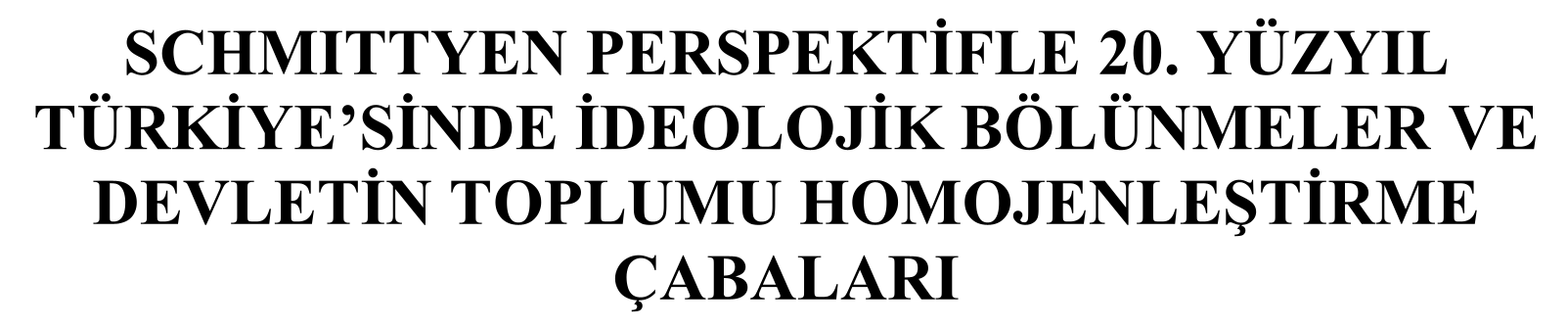
From a Schmıttian perspective, ideological divisions and the state's efforts to homogenize society in 20th century Türkiye
2026
254 sayfa
16 görüntülenme
3 i̇ndirme
Danışman: Dr. Öğr. Üyesi Celal Oral ÖZDEMİR
Özet (EN)
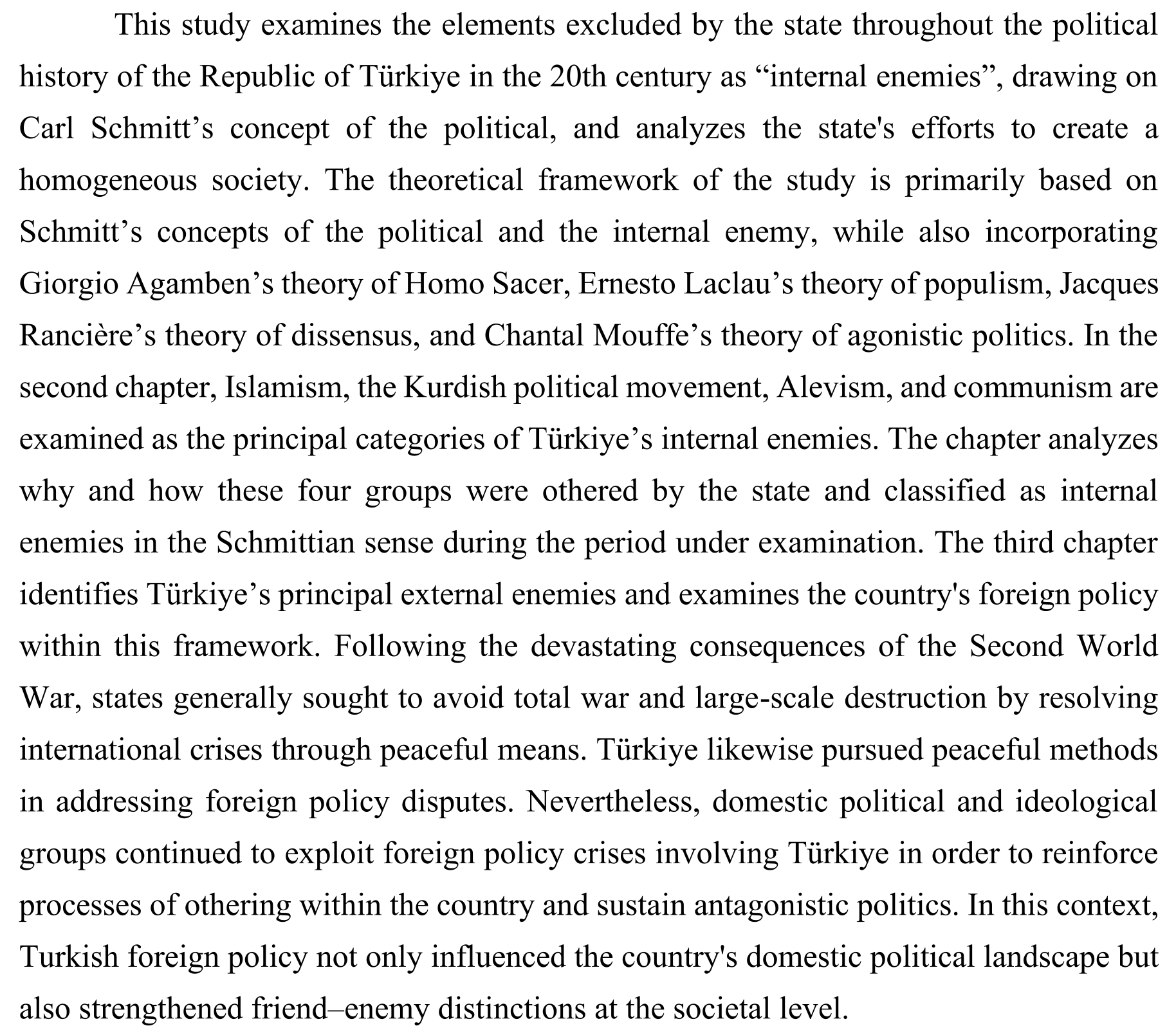
This study examines the elements excluded by the state throughout the political history of the Republic of Türkiye in the 20th century as “internal enemies”, drawing on Carl Schmitt’s concept of the political, and analyzes the state's efforts to create a homogeneous society. The theoretical framework of the study is primarily based on Schmitt’s concepts of the political and the internal enemy, while also incorporating Giorgio Agamben’s theory of Homo Sacer, Ernesto Laclau’s theory of populism, Jacques Rancière’s theory of dissensus, and Chantal Mouffe’s theory of agonistic politics. In the second chapter, Islamism, the Kurdish political movement, Alevism, and communism are examined as the principal categories of Türkiye’s internal enemies. The chapter analyzes why and how these four groups were othered by the state and classified as internal enemies in the Schmittian sense during the period under examination. The third chapter identifies Türkiye’s principal external enemies and examines the country's foreign policy within this framework. Following the devastating consequences of the Second World War, states generally sought to avoid total war and large-scale destruction by resolving international crises through peaceful means. Türkiye likewise pursued peaceful methods in addressing foreign policy disputes. Nevertheless, domestic political and ideological groups continued to exploit foreign policy crises involving Türkiye in order to reinforce processes of othering within the country and sustain antagonistic politics. In this context, Turkish foreign policy not only influenced the country's domestic political landscape but also strengthened friend–enemy distinctions at the societal level.
Kurum

Erzincan Binali Yıldırım University
Siyaset Bilimi ve Kamu Yönetimi Bilim Dalı
Bu Yayına Nasıl Atıf Yapılır
Samet Kocaman (Master Thesis). From a Schmıttian perspective, ideological divisions and the state's efforts to homogenize society in 20th century Türkiye , 2026, pp. 1-254, Erzincan Binali Yıldırım University, Siyaset Bilimi ve Kamu Yönetimi Bölümü, DOI: https://doi.org/10.71008/ebyu.thesis.2026.171.
Şekiller ve Görseller (3)
Anahtar Kelimeler
DOI Durumu
Talep Edildi
İnceleniyor
Onaylandı
DOI Atandı
DOI & Atıf Yap
Lisans
Tüm Hakları Saklıdır
Bu eser belirtilen lisans koşulları altında paylaşılmaktadır.
Erzincan Binali Yıldırım University tezlerinden daha fazlası
- Anatolia and Anatolian people in Ömer Bedrettin Uşaklı’s poems(2022)
- Bayburtlu Ağlar Baba Divanı's contextual index and functional dictionary(2025)
- The effect of peer mathematics anxiety on students’ mathematics anxiety and achievement(2026)
- YAPAY ZEKA VE PROGRAMLAMA: ÖĞRETMENLERİN PROGRAMLAMA ÖZ YETERLİLİKLERİ, YAPAY ZEKA FARKINDALIKLARI VE EĞİTİMDE YAPAY ZEKA KULLANIMINA İLİŞKİN GÖRÜŞLERİNİN İNCELENMESİ(2026)
- Investigation of structural behavior of corroded RC columns(2020)
- The role of fear of missing out in social environments and nomophobia as a situational mediator in the relationship between self-control and academic procrastination in adolescent athletes(2026)