
Sobolev and logarithmic sobolev inequalities
1990
0 views
0 downloads
Advisor: Prof.dr. Cevdet Koçak
Abstract (EN)
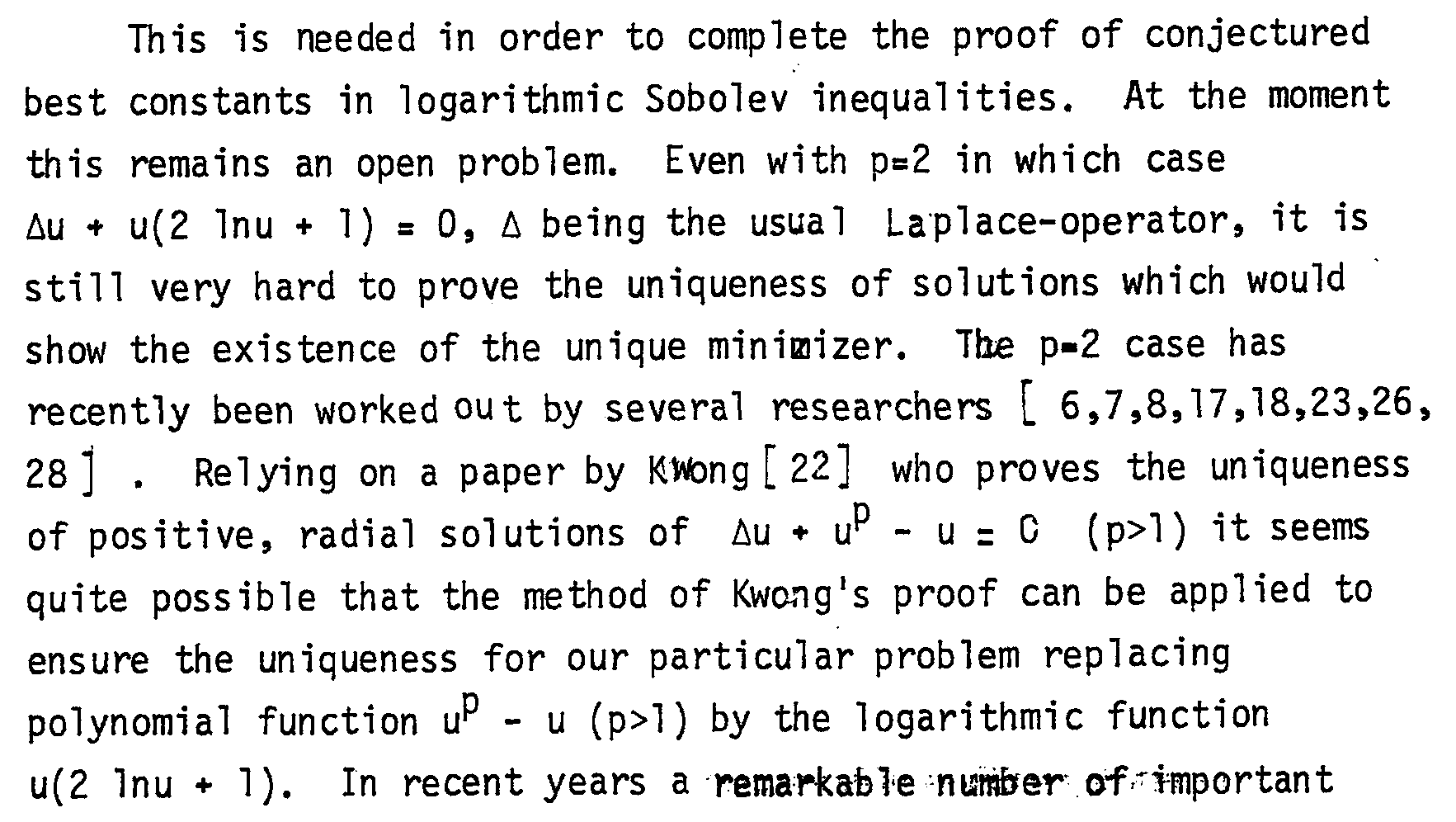
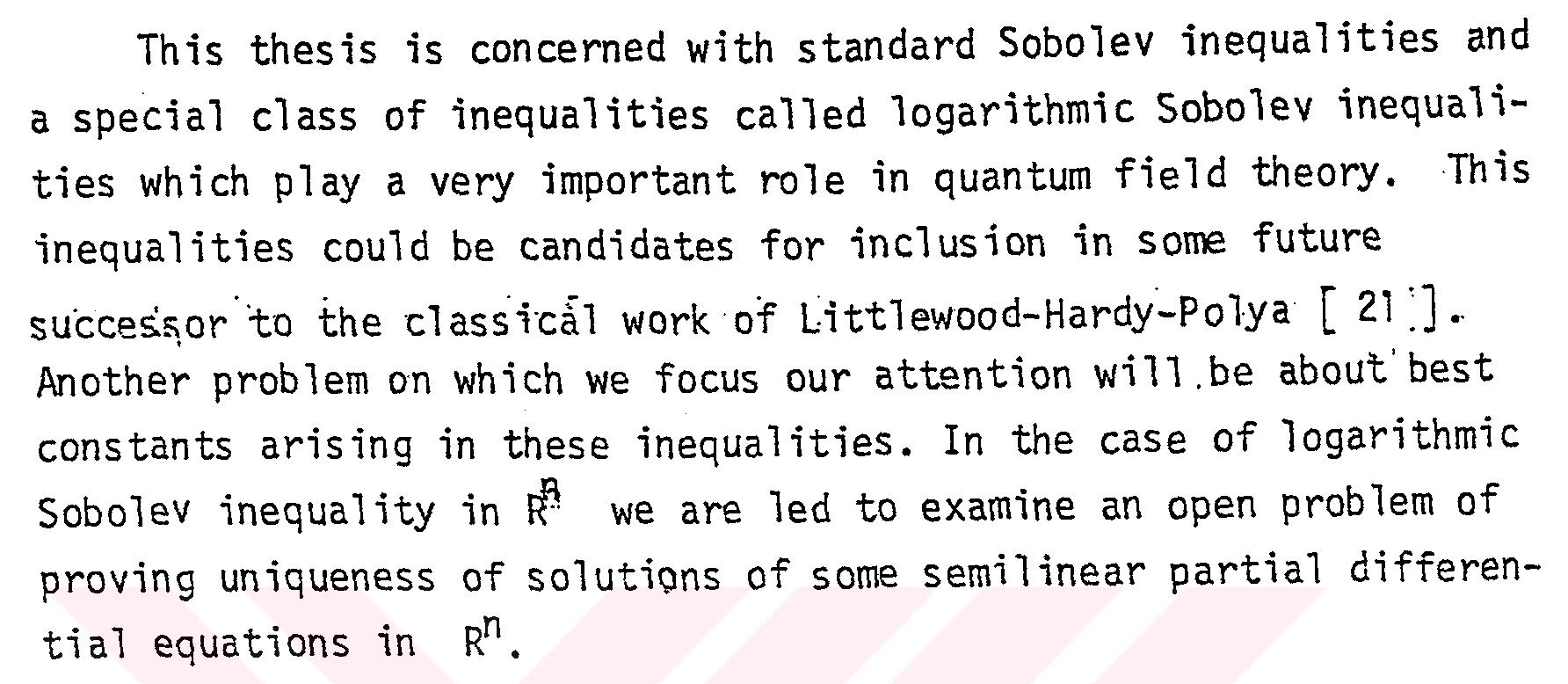
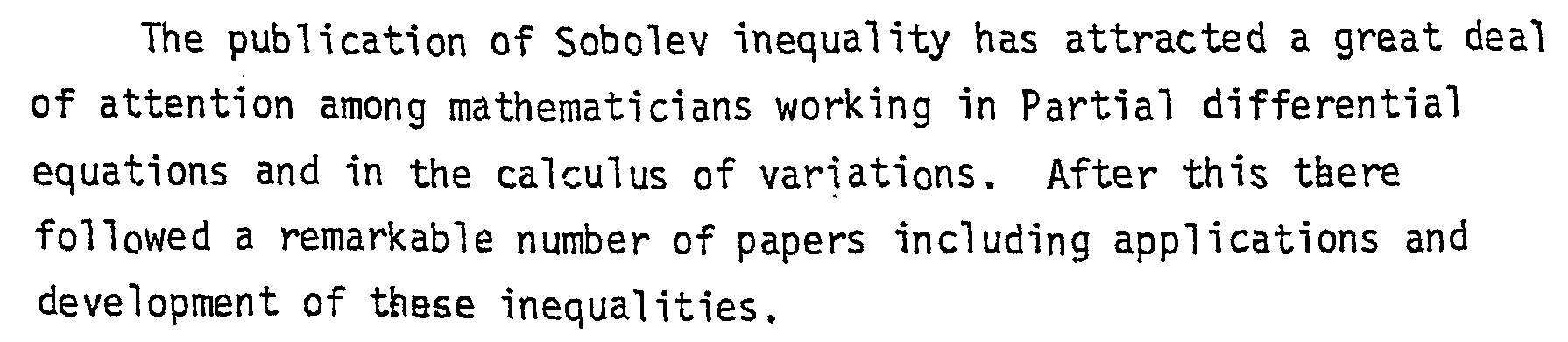
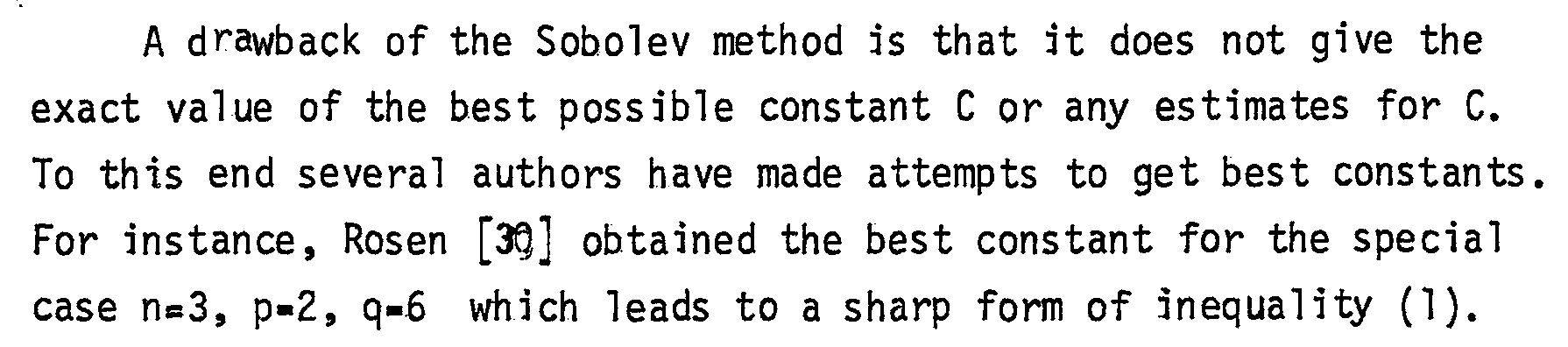
SOBOLEV AND LOGARITHMIC SOBOLF.V INEQUALITIES SUMMARY This thesis is concerned with standard Sobolev inequalities and a special class of inequalities called logarithmic Sobolev inequali ties which play a very important role in quantum field theory. This inequalities could be candidates for inclusion in some future successor to the classical work of Littlewood-Hardy-Polya [ 21 ;].. Another problem on which we focus our attention will.be about' best constants arising in these inequalities. In the case of logarithmic Sobolev inequality in R^ we are led to examine an open problem of proving uniqueness of solutions of some semilinear partial differen tial equations in Rn. We call any inequality expressing the boundedness of a map from L to L^ a Sobolev type inequality or more precisely, INIlV),c|1vu||lV) (1) where q= np/ n-p, l n * -X / |vu| dx (2) The constant appearing in (2) is the best possible. For the general case l|P dx.»/ |*|P lnlol dx- ||ç^i|Pjp ln|||lnjP Rn Rn (5) ? k ||l by adapting the method of Adams and Clarke. Unfortunately, the induction method fails to generalize when p^2. We have the following theorem: Let u: R -*? C be a continuously differentiable function. Then for p>l p-Vlu'lP dx * /|u|p ln|u| dx - 1{U|1P ln ||u|| *k ||u||p (6) R R IXwhere k = -U 1+ln ( (p-Dİ/P-L-rc-i^))] p p p p is the best possible constant. The equality holds in (6) if u has the form u(x) = xexp {-_l_|x+ujq } where p and q are pairs of conjugate indices, i.e. p + q » 1 9 2 1/? and A and y are positive constants and |x| * (x, + + y£ ). The last chapter concentrates on the investigation of the tricky uniqueness problem of the positive, radial solutions of the equation: A u ¥ up_1 (plnu + 1) r 0 (7) r A u being the p- Laplacian of u defined by V.div(|Vu|P-2vu) and u is a symmetric rearrangement. This is needed in order to complete the proof of conjectured best constants in logarithmic Sobolev inequalities. At the moment this remains an open problem. Even with p=2 in which case Au + u(2 Inu + 1) = 0, A being the usual Laplace-operator, it is still very hard to prove the uniqueness of solutions which would show the existence of the unique mininizer. The p-2 case has recently been worked out by several researchers [ 6,7,8,17,18,23,26, 28 j. Relying on a paper by Kttong[22] who proves the uniqueness of positive, radial solutions of Au ? u^ - u r C (p>l) it seems quite possible that the method of Kwong's proof can be applied to ensure the uniqueness for our particular problem replacing polynomial function up - u (p>l) by the logarithmic function u(2 Inu + 1). In recent years a remarkable nura&er of -importantpapers [ 12 ] have been published concerning the existence and.nonexistence of solutions of p-Laplace equations. But the general uniqueness problem in A u +? u^" (plnu + 1) ; 0 is still unsolved. This would lead us to the best constants in (5), consequently we would get the sharp form of the logarithmic Sobolev inequality in l-P (Rn, dx) with dx Lebesgue measure in Rn. XI
Author
Dr. Faruk Güngör

How to Cite
Faruk Güngör (Doctorate thesis). Sobolev and logarithmic sobolev inequalities, 1990, Istanbul Technical University.
Figures & Images (89)
Keywords
License
Tüm Hakları Saklıdır
This work is shared under the specified license terms.
More theses from Istanbul Technical University
- Removal and recovery of platinum group metals through anode slimes of moebius electrolysis(2015)
- Investigation Of Stretching Effect With Mixed Finite Element Formulations For Laminated Beams And Plates(2023)
- Classification of anemia using data mining methods: An application(2015)
- A study of design approaches to Istanbul's city halls based on space syntax theory(2015)
- A II. German Empire project: From Kaiser Wilhelm Monument to German fountain(2015)
- Uzaktan algılama verilerinin yersel ölçümlerle entegrasyonu ile toprak tuzluluk haritalaması; Aşağı Seyhan Ovası, Adana, Türkiye(2015)