
 indexed
Investigation of the relationship between digital addiction, social anxiety, and perceived social support among university students
Abstract (EN)
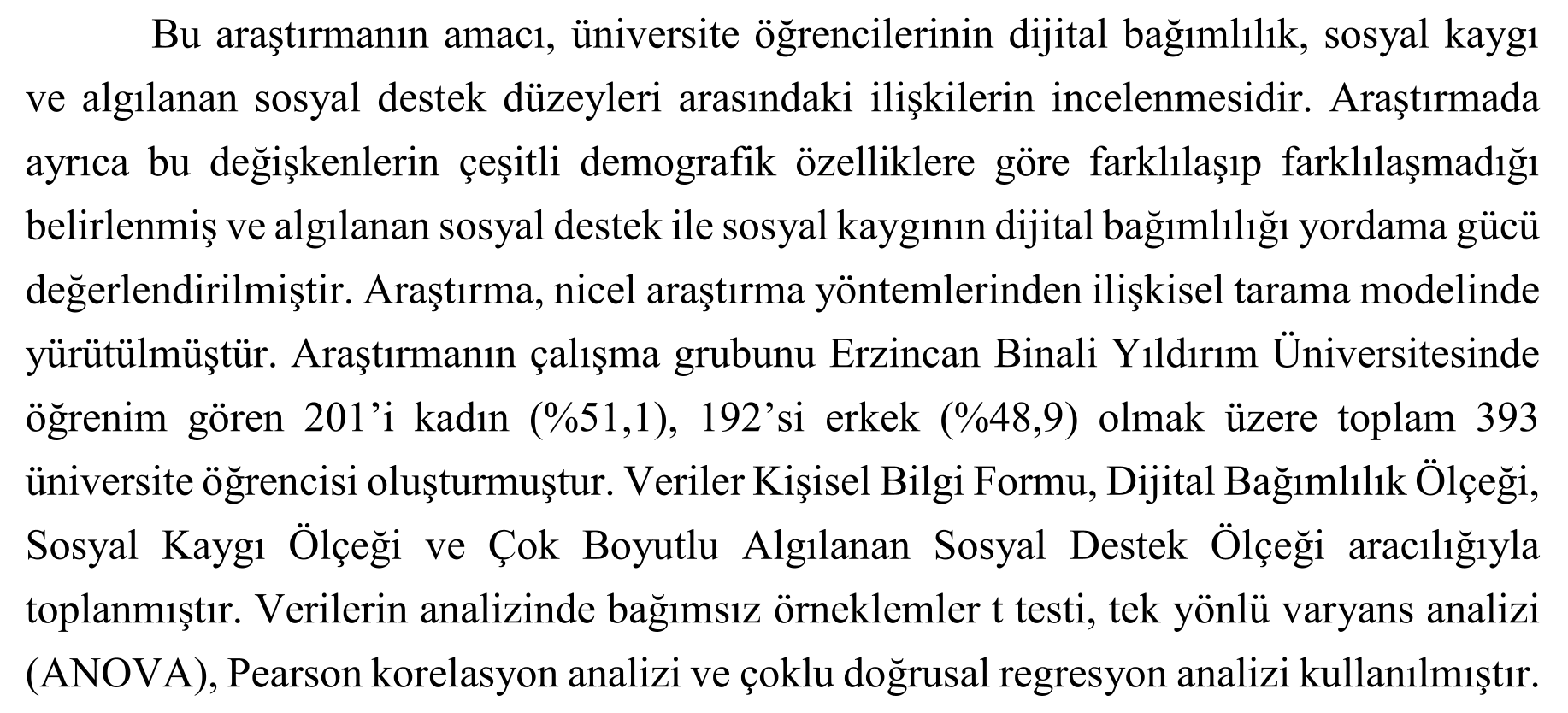
The aim of this study was to examine the relationships among digital addiction, social anxiety, and perceived social support levels of university students. In addition, it was investigated whether these variables differed according to various demographic characteristics, and the predictive power of perceived social support and social anxiety on digital addiction was evaluated.
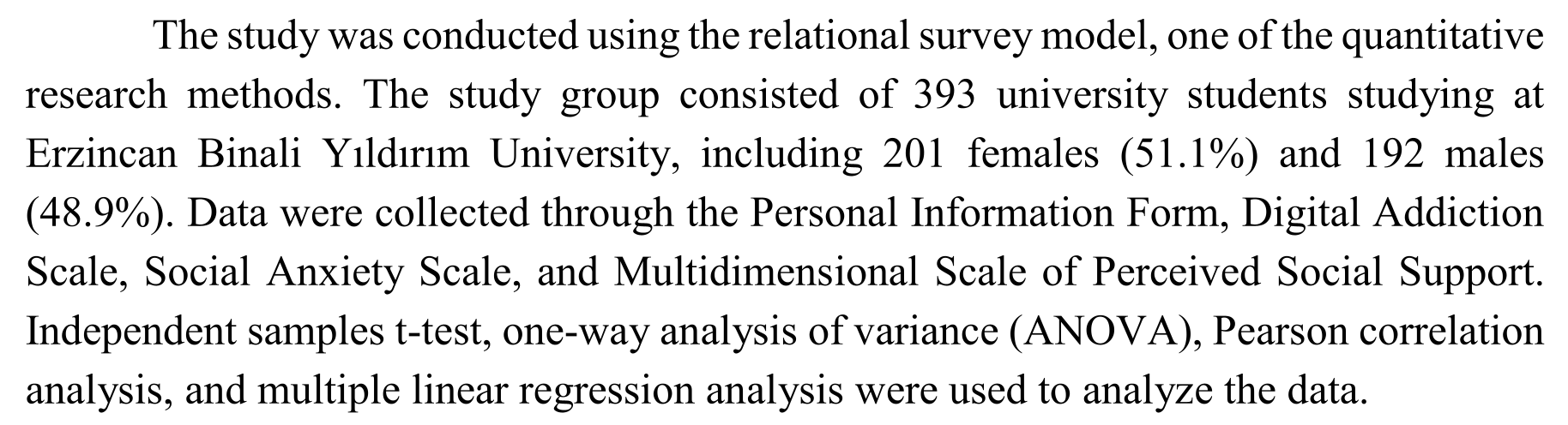
The study was conducted using the relational survey model, one of the quantitative research methods. The study group consisted of 393 university students studying at Erzincan Binali Yıldırım University, including 201 females (51.1%) and 192 males (48.9%). Data were collected through the Personal Information Form, Digital Addiction Scale, Social Anxiety Scale, and Multidimensional Scale of Perceived Social Support. Independent samples t-test, one-way analysis of variance (ANOVA), Pearson correlation analysis, and multiple linear regression analysis were used to analyze the data.
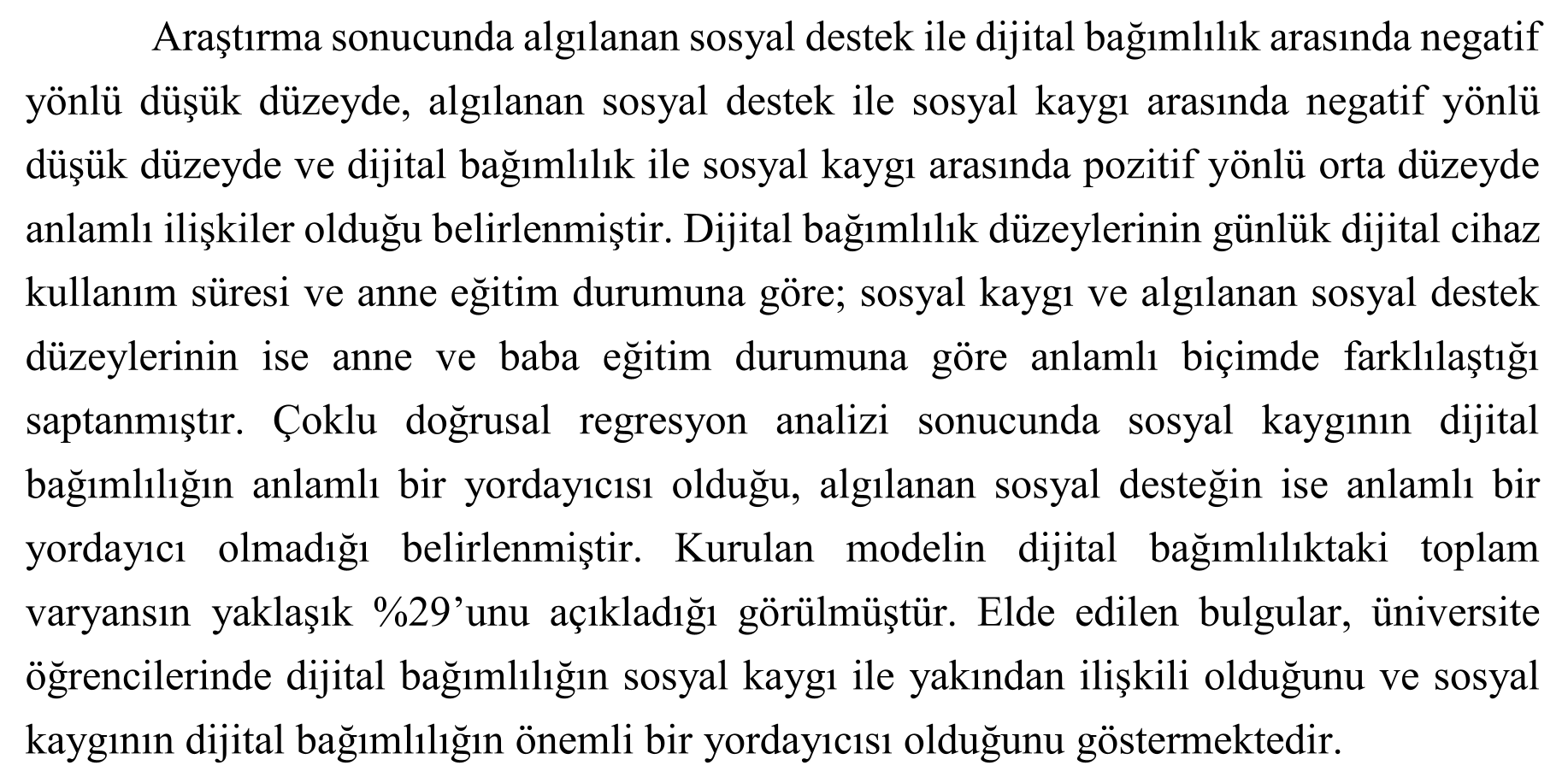
The findings indicated significant low-level negative relationships between perceived social support and digital addiction, and between perceived social support and social anxiety, whereas a significant moderate-level positive relationship was found between digital addiction and social anxiety. Digital addiction levels differed significantly according to daily digital device usage duration and mothers’ educational status. Social anxiety and perceived social support levels, on the other hand, differed significantly according to both mothers’ and fathers’ educational status. The results of multiple linear regression analysis revealed that social anxiety was a significant predictor of digital addiction, whereas perceived social support was not a significant predictor. Furthermore, the model explained approximately 29% of the total variance in digital addiction. The findings suggest that digital addiction is closely associated with social anxiety among university students and that social anxiety is an important predictor of digital addiction.
Institution

How to Cite
Burcu Özerli (Master Thesis). Investigation of the relationship between digital addiction, social anxiety, and perceived social support among university students, 2026, pp. 1-1, Erzincan Binali Yıldırım University, Rehberlik ve Psikolojik Danışmanlık Bölümü, DOI: https://doi.org/10.71008/ebyu.thesis.2026.252.
Figures & Images (6)

Keywords
DOI & Cite
License
Tüm Hakları Saklıdır
This work is shared under the specified license terms.
More theses from Erzincan Binali Yıldırım University
- Bayburtlu Ağlar Baba Divanı's contextual index and functional dictionary(2025)
- Anatolia and Anatolian people in Ömer Bedrettin Uşaklı’s poems(2022)
- From a Schmıttian perspective, ideological divisions and the state's efforts to homogenize society in 20th century Türkiye (2026)
- The effect of peer mathematics anxiety on students’ mathematics anxiety and achievement(2026)
- The role of fear of missing out in social environments and nomophobia as a situational mediator in the relationship between self-control and academic procrastination in adolescent athletes(2026)
- The conditional indirect role of mindfulness and perceived social support in the relationship between mind-wandering and psychological flexibility through stress in athletes(2026)